Progression in Strength Training - Why More Weight Isn't the Only Lever
Progression is considered a core principle of strength training. If you want to build muscle, you need to give your body stronger stimuli over time.
 10 Reps Editorial
- 1Progression is more than just adding weight - more stable reps, more reps at the same load, and better recovery all count too.
- 2As training experience grows, the effect of pure weight increases flattens out - progress often becomes "invisible" even though it's happening.
- 3Progression works best when load increases only after a level of performance has proven repeatable, not when forced on a fixed schedule.
Progression is considered a core principle of strength training. If you want to build muscle, you need to give your body stronger stimuli over time. In practice, though, progression often gets reduced to a single variable: more weight on the bar. When that increase stalls, it quickly feels like training "isn't working anymore" — even though you're training consistently and the effort still feels high.
In reality, progression is far more layered — and it works best precisely when it isn't pinned to a single number.
Why weight alone isn't enough
In your first few months of training, adding weight tends to reliably produce progress. Technique improves, neural adaptations kick in, and strength numbers climb visibly. As training experience builds up, though, this effect flattens out.
That doesn't mean muscle growth stops — it means weight loses its value as the sole lever. If you try to force progress purely through heavier loads, you risk breakdowns in technique, unnecessary fatigue, or stalled performance despite maximum effort. Progression becomes ineffective when it's only viewed short-term.
Progression means development over time
Strictly speaking, progression doesn't describe a single session — it describes how the training stimulus changes over weeks and months. Muscle growth comes from repeated, thoughtfully increasing load, not from constant maximum attempts.
Besides weight, there are other effective levers:
All of these factors can increase the training stimulus without necessarily moving more weight.
Why progression often stays "invisible"
A common frustration: training feels hard, but progress is hard to pin down. Many people feel like they're stuck in place — even though their performance and capacity have already changed.
Progression often shows up indirectly:
Without a bigger-picture view, these developments are easy to miss. Progress is there — it just isn't recognized as progress.
Increasing too early or too late slows progress
Progression isn't just a question of how — it's also a question of when. Increasing too early often leads to unstable technique or unnecessary fatigue. Increasing too late keeps the training stimulus below where it needs to be.
What matters is a repeatable performance level. Only once a load has been handled consistently across several sessions does it make sense to take the next step. Progression works best when it's derived, not forced.
Progression needs context
A core problem with many training approaches: progress is viewed in isolation. Individual exercises or weights get judged without placing them in the bigger picture.
Progress can't be meaningfully assessed without knowing the context:
Without this context, progression ends up either too aggressive or too cautious — either way, it can slow long-term muscle growth.
Progression is management, not a competition
A common myth in strength training is the idea that every session has to be "better" than the last. In reality, progression moves in waves: phases of stable performance, small adjustments, occasional deloads.
It's precisely this steady management that makes long-term progress possible. Progression doesn't mean constantly pushing to the limit — it means adjusting the load so that adaptation stays possible.
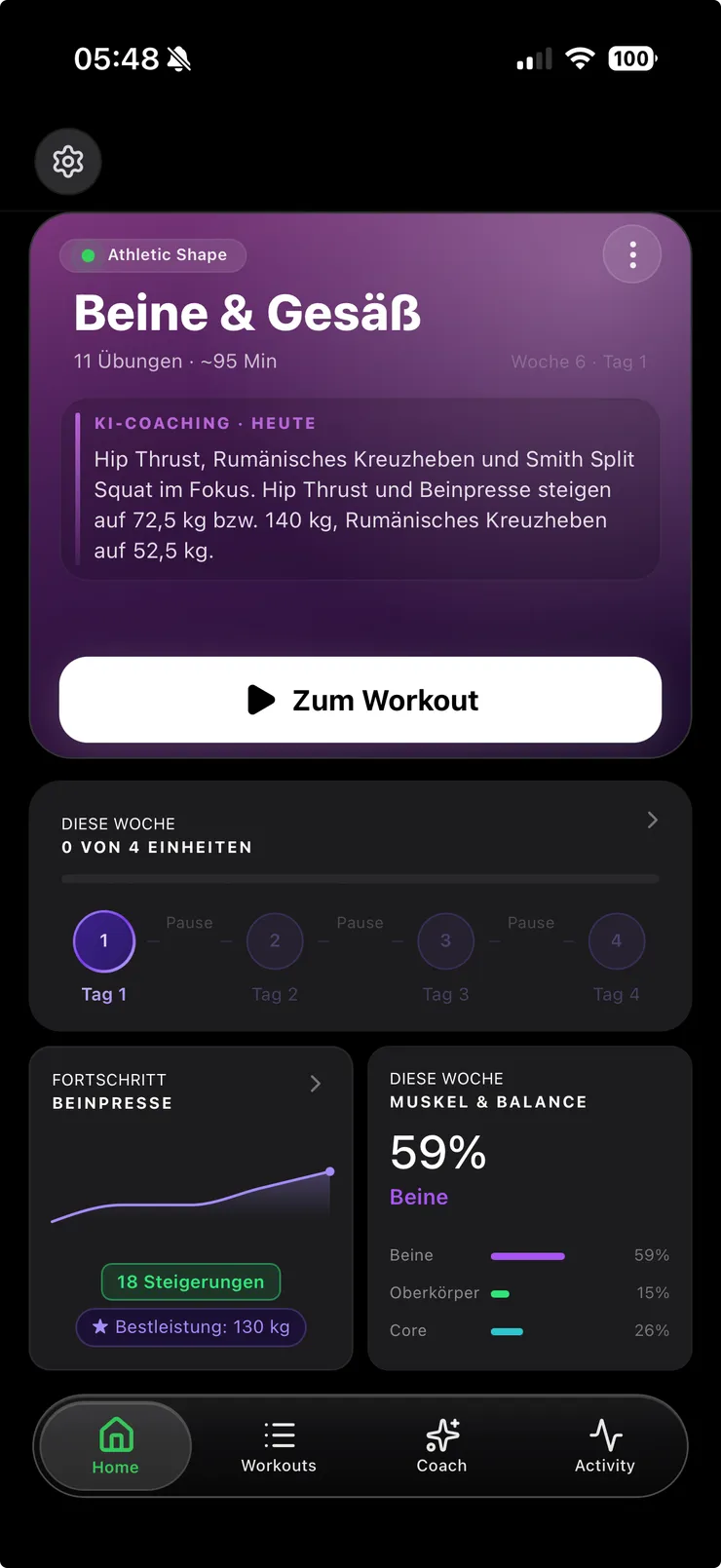
OUR APPROACH AT 10 REPSAt 10 Reps, progression isn't left to chance or decided day by day — it's part of a clear structure. Training gets tracked over time, and load and volume are coordinated and adjusted step by step.
You don't have to figure out yourself when and how progression makes sense. 10 Reps guides you through clear training structures and shows you which adjustment fits your current level. That way, progress stays traceable, steady, and effective in the long run.
Conclusion: Progress comes from structure, not pressure
Muscle growth rarely stalls because you're training too little — it stalls because progression is thought about too one-dimensionally. More weight is one possible lever, but not the only one. What matters is how load is managed over time. If you understand progression as a system, you build the foundation for sustainable muscle growth — without constant performance pressure.
Continue reading


Knowledge is the start.
The plan does the rest.
Everything we write about here — progression, recovery, structure — is built right into the app. 5 questions, and your first plan is ready.
Download on theApp Store