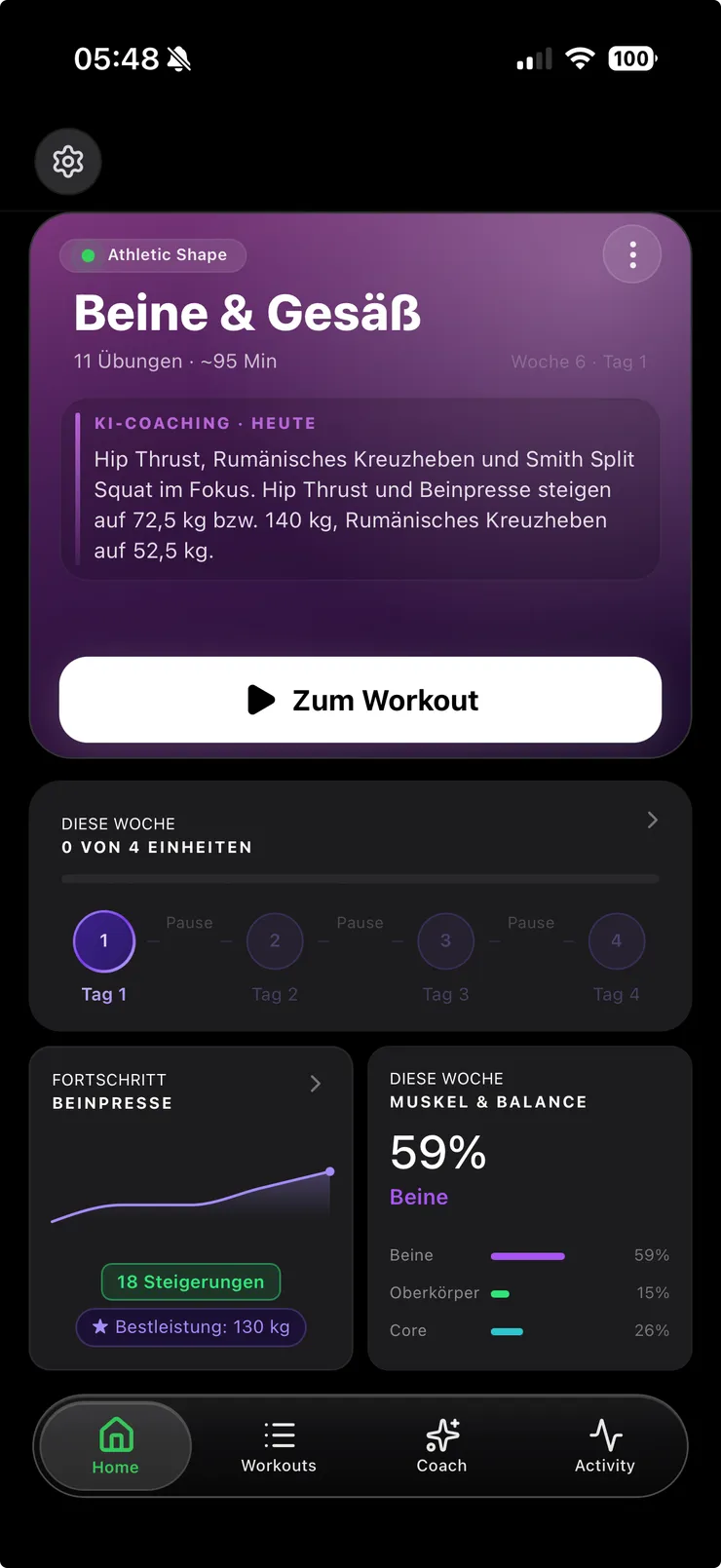
Split Training Plan - Structured Muscle Growth at the Gym
When workouts keep getting longer but progress doesn't follow, it's rarely down to motivation - it's usually down to structure.
 10 Reps Editorial
- 1A split spreads high training volume across multiple days rather than cramming it into one long session - not because it's inherently better than full-body training.
- 2A 3-day split allows roughly 10 to 16 effective sets per muscle group per week, with sessions typically running 60 to 70 minutes.
- 3A 5-day split trains each muscle group only once a week with very high volume - not fundamentally superior, and makes sense only for very experienced athletes.
When workouts keep getting longer but progress doesn't follow, it's rarely down to motivation - it's usually down to structure. For many advanced lifters, a split training plan is the next logical step once full-body training hits its organizational limits. Instead of training several major muscle groups in every session, training gets spread across multiple days. That makes it possible to manage training volume, intensity, and recovery more precisely - provided the split is chosen wisely and followed consistently.
In this article, we'll cover what defines a split training plan, who it's useful for, how 3-day, 4-day, and 5-day splits differ - and why 10reps deliberately builds structured 3-day split training plans.
What is a split training plan?
A split training plan divides strength training across several training days, each targeting different muscle groups or movement patterns. Unlike full-body training, where several muscle groups get loaded within one session, a split focuses on clearly separated training days.
A classic example is the 3-day split: Push: chest, shoulders, triceps. Pull: back, biceps. Legs: lower body.
A split doesn't beat full-body training on its own merits - what it actually buys you is the ability to distribute higher training volume cleanly, without making individual sessions unnecessarily long or exhausting.
A split isn't a tool for training more - it's a tool for training in a more structured way.
A split training plan is especially suited for people who:
For absolute beginners or irregular training, a split usually isn't the best choice.
How is a split training plan structured?
A split training plan usually follows a clearly structured weekly rhythm, where each training day has a distinct focus. Every session serves a clear purpose - not "a bit of everything." Common variations include:
Most sessions include 4-6 targeted exercises with 3-4 working sets. What matters isn't the number of exercises, but the effective weekly volume per muscle group. That usually lands somewhere in the 10-20 working sets per week range - depending on training level, recovery capacity, and everyday life.
Muscle growth doesn't come from variety - it comes from progression. That happens through:
We don't schedule deload phases on a fixed calendar or by rote - we use them when performance stalls or fatigue becomes clearly noticeable.
Advantages of a split training plan
Split training plans offer the biggest advantage once the training volume needed for muscle growth increases and no longer fits neatly into individual sessions. Spreading that volume across multiple training days doesn't just distribute it better - it also lets you execute it with quality, without making individual sessions excessively long.
The clear separation between training days also ensures sufficient functional recovery between intense loads. After a push session, chest, shoulders, and triceps aren't loaded heavily again directly or indirectly - they get several days of recovery before being trained again. That reduces cumulative fatigue and improves the training quality of following sessions.
The result: more targeted load management, more consistent performance across the training week, and more sustainable progression instead of short-term overload.
3-Day, 4-Day, and 5-Day Splits, Compared
Split training plans differ mainly in training frequency, weekly volume, and organizational effort. What matters isn't the number of training days itself, but how well load and recovery fit your individual training reality. More training days don't automatically mean better results.
3-day split training plan - our preferred structure for advanced lifters
In our view, the 3-day split training plan (e.g., Push / Pull / Legs) has proven to be a particularly well-balanced and practical solution for advanced lifters. Each muscle group is typically trained once or twice a week - depending on whether you're doing three or four sessions per week.
This structure allows for:
Compared to very high-frequency full-body training, the 3-day split lets you implement higher volumes cleanly, predictably, and sustainably. At the same time, sessions typically stay in the 60-70 minute range, which makes the plan realistically fit into everyday life.
That's why, for advanced users, 10reps deliberately relies on structured 3-day split training plans, where volume, progression, and recovery are systematically coordinated.
4-day split training plan - more specialization, higher demands
A 4-day split training plan allows for a finer distribution of training volume and is often used by people who can reliably commit to four fixed training days a week. Depending on the setup, muscle groups get trained either once a week with higher volume or twice with moderate volume (e.g., upper body / lower body).
The advantage lies in more targeted loading of individual muscle groups and the ability to address weak points more specifically. At the same time, though, the demands on recovery management, exercise selection, and progression control increase, since total weekly volume is often higher. Without clean planning, the 4-day split quickly becomes inefficient.
5-day split training plan - a specialized variant with clear limits
The 5-day split training plan originally comes from classic bodybuilding and usually trains each major muscle group only once a week, but with very high volume. This training style requires very good recovery capacity, sufficient sleep, and consistently well-adjusted nutrition.
The research doesn't back the idea that this variant is fundamentally superior. For many people who train, the low training frequency per muscle group is a limiting factor. The 5-day split can work, but it's error-prone and only makes sense for a small, very experienced group.
Conclusion: Which split training plan makes sense?
A split training plan isn't an end in itself and isn't a performance guarantee - it's a tool for structuring training volume in a controlled, sustainable way over the long term. For most advanced lifters, the 3-day split training plan offers the best balance of sufficient training stimulus, functional recovery, and everyday practicality.
In short:
3-day split: balanced, sustainable, the smartest choice for many advanced lifters
4-day split: more specialization, higher demands on recovery and planning
5-day split: highly specialized, only makes sense for very experienced athletes
What matters isn't the split itself, but whether training volume, intensity, and recovery fit together over weeks and months. Structure beats complexity - especially when progress is meant to count in the long run.
Continue reading


Knowledge is the start.
The plan does the rest.
Everything we write about here — progression, recovery, structure — is built right into the app. 5 questions, and your first plan is ready.
Download on theApp Store