Bench Press: How to Target the Middle and Lower Chest
The flat bench press is the foundation of chest training. Here's how to do it correctly with a barbell and avoid the mistakes that cost strength or strain the shoulder.
 10 Reps Editorial
The flat bench press is the foundation on which the other four chest exercises in our overview article "The 5 Best Chest Exercises" build. Here we go deeper: how do you perform the exercise correctly with a barbell, why does it load the middle and lower part of the chest so strongly - and which mistakes cost you strength or put unnecessary strain on your shoulder?
- 1Starting position:
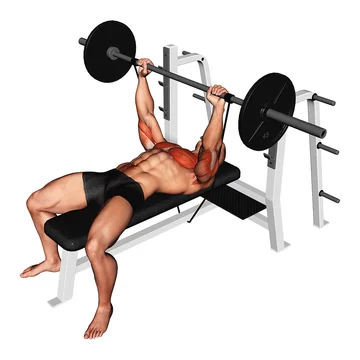
Lie on your back on the flat bench, feet planted firmly on the floor. Shoulder blades pulled together and "locked" into the bench. Grip shoulder-width to slightly wider.
1Starting position: Lie on your back on the flat bench, feet planted firmly on the floor. Shoulder blades pulled together and "locked" into the bench. Grip shoulder-width to slightly wider. - 2Downward movement:
Lower the bar under control to your lower chest. Keep your elbows at a moderate angle to your body - neither fully tucked in nor flared out at a right angle.
2Downward movement: Lower the bar under control to your lower chest. Keep your elbows at a moderate angle to your body - neither fully tucked in nor flared out at a right angle. - 3Brief contact point:
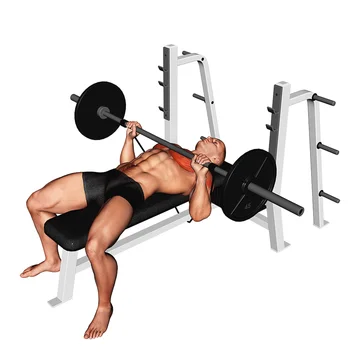
The bar touches your lower chest without bouncing off it.
3Brief contact point: The bar touches your lower chest without bouncing off it. - 4Upward movement:
Press up actively, guiding the bar back slightly diagonally to the starting position above your shoulders.
4Upward movement: Press up actively, guiding the bar back slightly diagonally to the starting position above your shoulders. - 5Breathing:
Inhale as you lower, exhale as you press up.
5Breathing: Inhale as you lower, exhale as you press up.
Fixed shoulder blades are the basis of the entire movement: if they lift off the bench during the set, the exercise loses both stability and force transfer.
Why this exercise is so effective
The large chest muscle (pectoralis major) consists of several portions - an upper, collarbone-side part (clavicular head) and a middle-to-lower, breastbone-side part (sternocostal head). Which portion works hardest shifts with the angle of the bench. In the flat bench press, that is mainly the middle and lower portion - unlike the incline press, which targets the upper part more.
Three reasons the flat bench press is the foundational exercise in chest training:
Common mistakes
Variations
Sets and reps
As a foundational exercise, the flat bench press is typically programmed in training practice with a range of around 3-4 sets of 6-12 reps, with 1-3 reps left in reserve at the end of each set (RIR 1-3). This, too, is a general guideline, not a rigid rule.
OUR APPROACH AT 10 REPSIn the 10 Reps app, the flat bench press is part of several training plans, including push and upper-body focused programs. The ProgressionEngine doesn't lock weight and reps in place - it adjusts them based on your feedback from the last session. Train consistently and cleanly, and the load goes up; need more recovery, and you get it, without the plan grinding to a halt.
Built-in deload weeks also make sure load gets reduced automatically on a regular basis, so you don't have to keep track of that yourself.
Conclusion
The flat bench press lives on a stable base - fixed shoulder blades, planted feet - and a controlled movement without bouncing.
Get those two things right and you'll get both maximum strength and a targeted stimulus on the middle and lower chest from the foundation exercise of chest training.
Part of our chest-exercises series - discover more essential chest exercises here: The 5 Best Chest Exercises.
Continue reading

Knowledge is the start.
The plan does the rest.
Everything we write about here — progression, recovery, structure — is built right into the app. 5 questions, and your first plan is ready.
Download on theApp Store