Chest Press Machine: Why It Makes Most Sense at the End of Your Workout
The chest press machine isn't a compromise compared to free weights - it's a strong tool for your final sets. Here's how to do it correctly and avoid the typical mistakes.
 10 Reps Editorial
While the flat bench press and incline press from our overview article "The 5 Best Chest Exercises" use free weights, the chest press machine takes over part of the work - and that's exactly what makes it a useful tool at a specific point in your workout. Here we go deeper: the correct form, why the guided movement path has its own advantages - and which mistakes to avoid.
- 1Starting position:
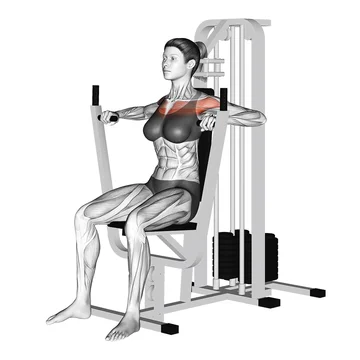
Back flat against the backrest, seat height set so the handles sit at about chest height. Grab the handles.
1Starting position: Back flat against the backrest, seat height set so the handles sit at about chest height. Grab the handles. - 2Forward movement:
Press the handles forward until your arms are almost straight - don't lock your elbows out hard at the end.
2Forward movement: Press the handles forward until your arms are almost straight - don't lock your elbows out hard at the end. - 3Brief tension phase at the front:
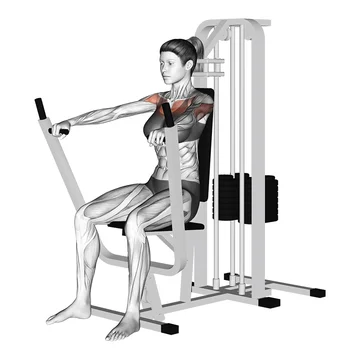
Hold the maximum chest contraction briefly.
3Brief tension phase at the front: Hold the maximum chest contraction briefly. - 4Return movement:
Bring the handles back under control, without letting the weight stack slam down at the bottom - that way tension in the chest is maintained throughout.
4Return movement: Bring the handles back under control, without letting the weight stack slam down at the bottom - that way tension in the chest is maintained throughout. - 5Breathing:
Exhale as you press, inhale as you return.
5Breathing: Exhale as you press, inhale as you return.
Why this exercise is so effective
The chest press machine works the large chest muscle through a movement path fixed by the machine - the triceps and front shoulder work as synergists, much like in the bench press with free weights.
Three reasons the machine has a firm place in chest training:
Common mistakes
Variations
Sets and reps
As a machine exercise that suits the final sets of a session especially well, the chest press is often programmed in a range of 2-4 sets of 10-15 reps - in the last set of a session, you can deliberately train closer to failure (RIR 0-1), while 1-2 reps in reserve (RIR 1-2) are enough in the earlier sets. This, too, is a general guideline, not a rigid rule.
OUR APPROACH AT 10 REPSIn the 10 Reps app, the chest press is part of several training plans, including push and upper-body focused programs. The ProgressionEngine doesn't lock weight and reps in place - it adjusts them based on your feedback from the last session. Train consistently and cleanly, and the load goes up; need more recovery, and you get it, without the plan grinding to a halt.
Built-in deload weeks also make sure load gets reduced automatically on a regular basis, so you don't have to keep track of that yourself.
Conclusion
The chest press machine isn't a compromise compared to free weights but an exercise with its own strength: because the stabilization work drops out, it can be taken closer to failure more safely than the flat or incline bench press.
An advantage you can deliberately save for the final sets of your session.
Part of our chest-exercises series - discover more essential chest exercises here: The 5 Best Chest Exercises.
Continue reading
Knowledge is the start.
The plan does the rest.
Everything we write about here — progression, recovery, structure — is built right into the app. 5 questions, and your first plan is ready.
Download on theApp Store