How Often Should You Strength Train?
Twice a week, three times, every other day? The answer depends less on a magic number than most people think - and more on how those days are actually used.
 10 Reps Editorial
- 1Training frequency isn't a growth lever on its own: spreading the same number of sets across once, twice, or three times a week makes little difference for muscle growth.
- 2What matters isn't the number of days, but weekly training volume per muscle group - frequency is mainly a question of organization.
- 3For most people, the sensible range sits between 2 and 5 training days a week - beginners do well with 2 to 3 full-body sessions.
Twice a week, three times, every other day? The answer depends less on a magic number than most people think - and more on how those days are actually used.
Two different questions that often get mixed up
"How often should I train" can mean two different things: how many days a week in total, and how often a single muscle gets worked per week. For a full-body plan, those are the same number - for a split, they're not. Someone training three days a week but hitting each muscle on only one of those days is training that muscle once a week, even though three sessions happen overall.
What the research actually shows
The old rule of thumb said training a muscle at least twice a week beats once. Look closer, though, and an important detail shows up - that advantage disappears once weekly training volume is properly equated. Spread the same number of sets across once, twice, or three times a week, and it makes little difference for muscle growth. Frequency on its own isn't an independent growth lever - it's mainly a question of how the necessary training volume gets fit in practically.
And that's exactly where frequency still matters: anyone who wants to train a lot quickly hits a practical limit with too few days a week. A single, very long session packed with sets is impractical and exhausting. Spreading volume across more days makes it easier to fit in with better quality - the real advantage of training more often lies in organization, not in some extra biological stimulus.
How many days actually make sense
For most people, the sensible range sits between two and five days a week. Beginners do well with two to three full-body sessions - training volume is already moderate early on, so more days don't add extra benefit. As experience grows, sensible training volume usually grows too, and more days then help fit that volume in without individual sessions running too long.
What this means for your practice
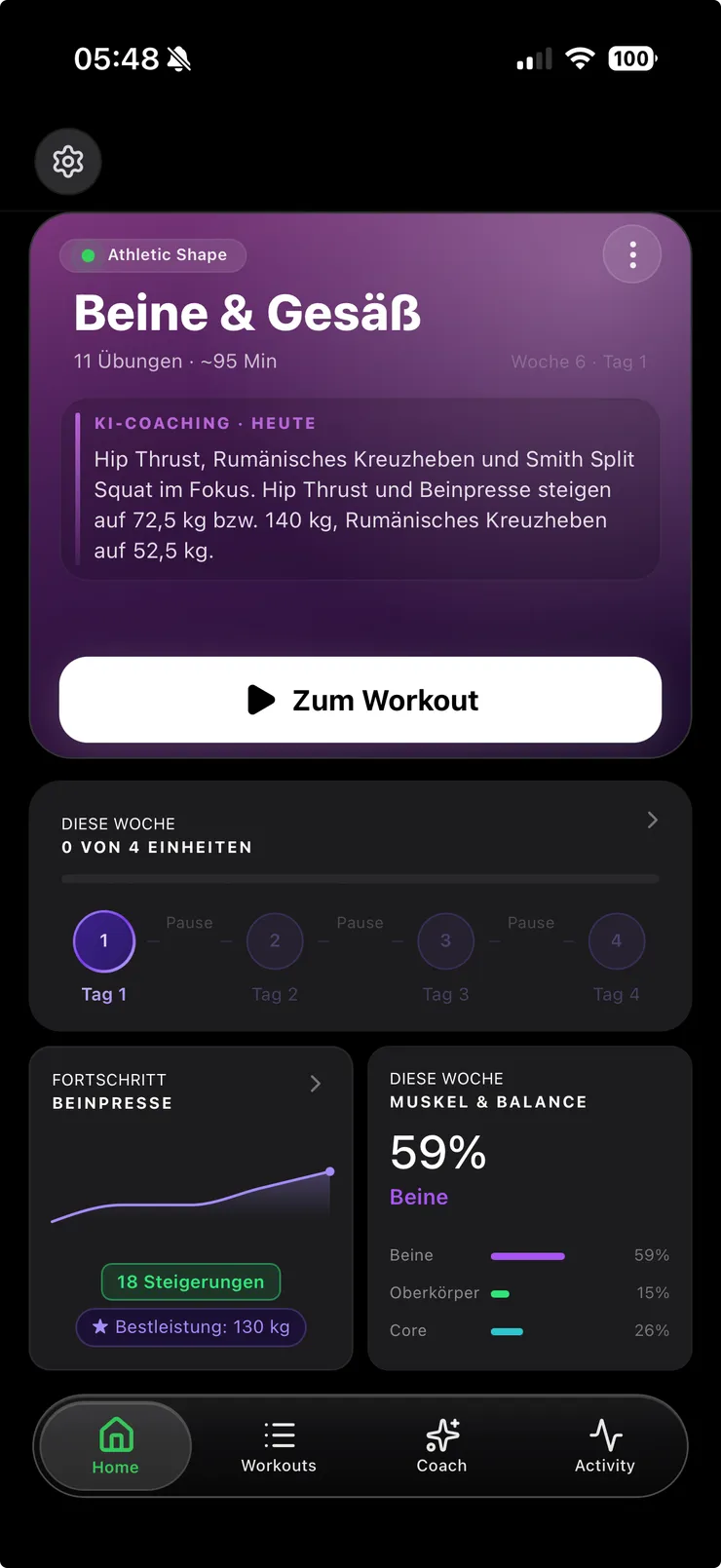
OUR APPROACH AT 10 REPSAt 10 Reps, you don't have to answer this question yourself. During onboarding, you tell us how many training days realistically fit your life, and the plan recommendation factors that in directly - the plans themselves are structured around 3 or 4 fixed sessions a week, with volume distributed accordingly.
You don't have to figure out yourself how often a muscle gets worked - the plan structure handles that.
Conclusion: The days are the tool, not the goal
How often you train is ultimately a question of organization, not a search for some secret optimum.
What matters is how much total training volume adds up - the number of days is just the means for fitting that volume in sensibly.
Continue reading


Knowledge is the start.
The plan does the rest.
Everything we write about here — progression, recovery, structure — is built right into the app. 5 questions, and your first plan is ready.
Download on theApp Store