Creatine and Strength Training - What Actually Holds Up
Hardly any supplement is as well researched as creatine - and hardly any is as often misunderstood. What it actually does for your training, and who it's worth it for.
 10 Reps Editorial

- 1Creatine raises your energy stores for short, intense efforts - combined with strength training, that adds a small, imaging-measurable extra effect on muscle growth.
- 2At recommended doses, creatine doesn't cause kidney damage in healthy people - 3 to 5 grams a day is enough, and a loading phase only speeds up the start.
- 3Timing barely matters - what counts is taking creatine consistently while doing strength training that sets the stimulus.
Hardly any supplement is as well researched as creatine - and hardly any is so often misunderstood at the same time. Somewhere between "makes you bloated" and "damages your kidneys," it often stays unclear what creatine actually does and who it's worth it for.
What creatine actually does in the muscle
Creatine increases the body's own stores of a substance that supplies instantly available energy for very short, intense efforts. In practice that means: slightly more reps in a hard set, one more rep at the end of a series, a slightly faster recovery between sets. On its own that sounds small - but over weeks and months it adds up to more training volume, and more training volume is one of the most reliable levers for strength and muscle growth.
What the combination with strength training adds
Combined with strength training, creatine shows a small additional effect on muscle growth, measured directly with imaging - on top of what training alone already delivers. That holds for both the upper and lower body. In the analysis, the effect came out somewhat larger in younger adults than in older ones.
Older adults benefit too: in a meta-analysis, older people taking creatine on top of strength training gained more lean mass, got stronger on the chest press and leg press, and did better on the chair-stand test than with strength training alone - an area that gains importance with age anyway. The evidence here is thinner than for younger adults, though.
The kidney worry - a myth that won't die
The idea that creatine harms the kidneys is one of the most persistent myths in fitness. An international expert group reviewed the evidence - more than 500 peer-reviewed publications on creatine exist - and concluded that at recommended doses, creatine does not cause kidney damage or kidney dysfunction in healthy people. Creatine is considered well tolerated; possible complaints mainly involve the digestive tract, for example with high single doses of more than 10 grams at once.
Dosing - simpler than most people think
Two routes lead to the same goal: either a short "loading phase" of about 20 grams a day for 5 to 7 days, or a constant 3 to 5 grams a day from the start. Both strategies lead to comparable saturation of the muscle's creatine stores - the loading phase just gets there faster (in a few days instead of around four weeks), but isn't necessary. If you're in no hurry, the simple, constant daily dose gets you there just the same. It also has an advantage: the loading phase can briefly add 1 to 3 kilograms of body weight, mostly from stored water - if you'd rather avoid that, stick with the constant dose.
What this means for your training
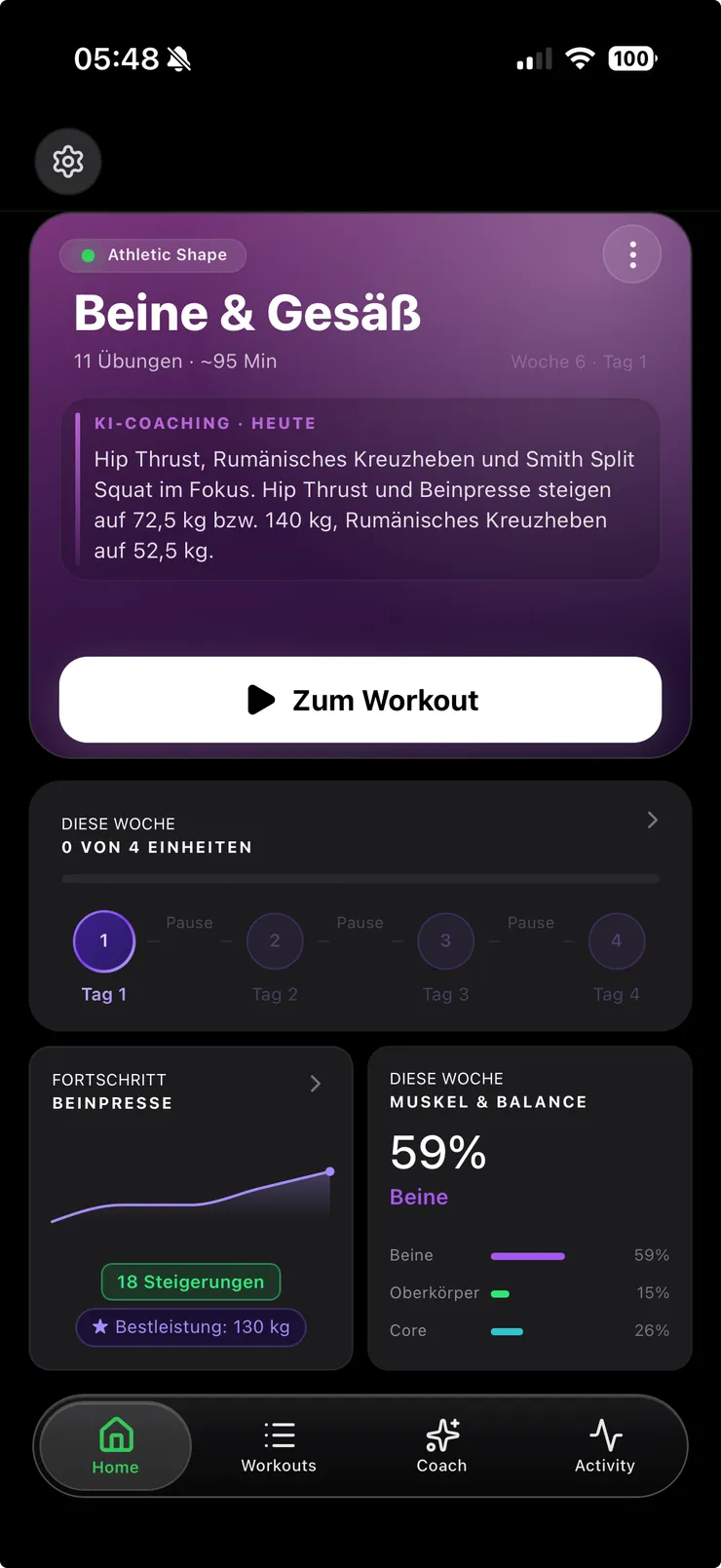
OUR APPROACH AT 10 REPS10 Reps doesn't track creatine or any other supplements - that's deliberate, similar to how we handle nutrition. What the app takes care of instead is making sure the training stimulus is there, the one creatine can only support in the first place.
The ProgressionEngine makes sure every session delivers real progress - so the extra bit of performance creatine can add lands on training that's already moving forward in a structured way.
Conclusion: No miracle product, but solidly backed
Creatine isn't a shortcut that replaces training - but it's one of the best-supported supplements there is, with a small but demonstrable extra benefit for anyone who already does strength training regularly.
For healthy people at recommended doses, the safety concerns have no basis, and dosing is simple - no reason to mystify it in either direction.
Continue reading


Knowledge is the start.
The plan does the rest.
Everything we write about here — progression, recovery, structure — is built right into the app. 5 questions, and your first plan is ready.
Download on theApp Store