Bulgarian Split Squat: What Makes It Different From Lunges
The Bulgarian split squat is often called a harder version of the lunge - but the elevated rear foot changes more than just the difficulty. Here's how to do it correctly.
 10 Reps Editorial
The Bulgarian split squat is often described as a "harder version" of the lunge - you already know both exercises briefly from our overview article "The 8 Best Leg Exercises for Stronger Legs". In reality, though, the elevated rear foot changes more than just the difficulty - it shifts the load almost entirely onto one leg. Here's how to perform the Bulgarian split squat correctly, what sets it apart from the classic lunge - and which mistakes cut into its effect.
- 1Starting position:
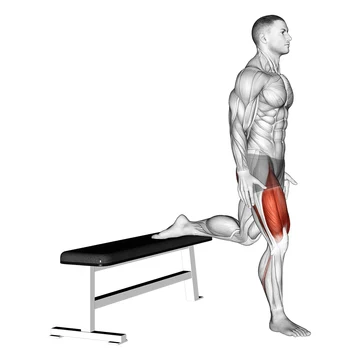
Stand a couple of steps in front of a flat bench, resting the top of your rear foot on it. Your front leg carries the main load, torso stays upright.
1Starting position: Stand a couple of steps in front of a flat bench, resting the top of your rear foot on it. Your front leg carries the main load, torso stays upright. - 2Downward movement:
Lower until your front thigh is roughly parallel to the floor. Your rear knee sinks toward the floor under control.
2Downward movement: Lower until your front thigh is roughly parallel to the floor. Your rear knee sinks toward the floor under control. - 3Bottom position:
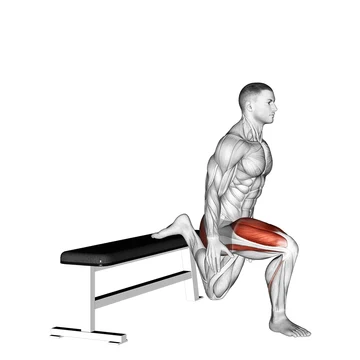
Brief control, your front knee stays stable over your foot.
3Bottom position: Brief control, your front knee stays stable over your foot. - 4Upward movement:
Press up through your front heel or midfoot until your front leg is extended again.
4Upward movement: Press up through your front heel or midfoot until your front leg is extended again. - 5Breathing:
Inhale on the way down, exhale on the way up.
5Breathing: Inhale on the way down, exhale on the way up.
The elevated rear foot is there purely for balance - if it visibly starts carrying load, part of the exercise's unilateral effect gets lost.
Why this exercise is so effective - and how it differs from lunges
Like the classic lunge, the Bulgarian split squat primarily works the quadriceps and glutes of the front leg. The decisive difference lies in how the load is distributed:
Common mistakes
Variations
Sets and reps
For the Bulgarian split squat, a range of roughly 3 sets of 8-12 reps per leg has become the established standard in training practice, with 1-3 reps left in reserve at the end of each set (RIR 1-3). This, too, is a general guideline, not a rigid rule.
OUR APPROACH AT 10 REPSIn the 10 Reps app, the Bulgarian split squat is part of several training plans, including lower-body-focused programs. The ProgressionEngine doesn't lock reps or added weight in place - it adjusts them based on your feedback from the last session. Train consistently and cleanly, and the load goes up; need more recovery, and you get it, without the plan grinding to a halt.
Built-in deload weeks also make sure load gets reduced automatically on a regular basis, so you don't have to keep track of that yourself.
Conclusion
The Bulgarian split squat isn't just a harder lunge - it's an exercise with its own character: almost entirely one-sided load, a greater range of motion, and a different kind of stability demand.
Alternate between both exercises and you train your leg muscles unilaterally from two different angles.
Part of our leg-exercises series - discover more essential leg exercises here: The 8 Best Leg Exercises for Stronger Legs.
Continue reading
Knowledge is the start.
The plan does the rest.
Everything we write about here — progression, recovery, structure — is built right into the app. 5 questions, and your first plan is ready.
Download on theApp Store