Hammer Curl: What Makes It Different From the Classic Bicep Curl
The hammer curl looks like a simple variation of the classic curl - it isn't. The neutral grip changes which muscles end up doing most of the work.
 10 Reps Editorial
The hammer curl looks at first glance like a simple variation of the classic bicep curl from our article "Barbell Bicep Curl" - just with dumbbells instead of a barbell. In reality, though, the neutral grip changes which muscles end up doing most of the work. Here's how to perform the hammer curl correctly, what sets it apart from the classic curl - and which mistakes cancel out the effect.
- 1Starting position:
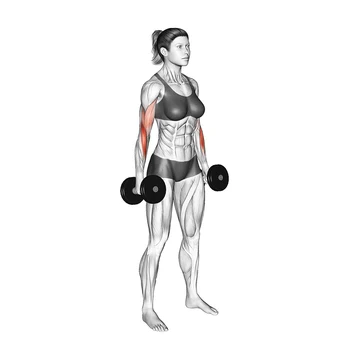
Hold the dumbbells in a neutral grip (palms facing each other) at your sides. Arms nearly fully extended, elbows close to your torso, shoulders relaxed down and back.
1Starting position: Hold the dumbbells in a neutral grip (palms facing each other) at your sides. Arms nearly fully extended, elbows close to your torso, shoulders relaxed down and back. - 2Upward movement:
Curl the dumbbell(s) up by bending your elbows. The neutral grip stays fixed throughout the movement - unlike the classic curl, your palms don't rotate upward.
2Upward movement: Curl the dumbbell(s) up by bending your elbows. The neutral grip stays fixed throughout the movement - unlike the classic curl, your palms don't rotate upward. - 3Brief squeeze at the top:
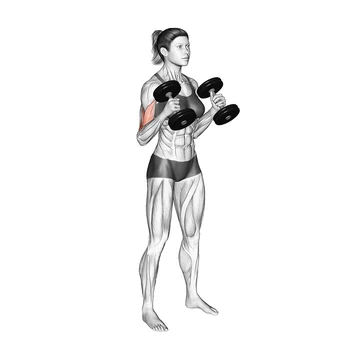
Briefly hold the contraction without carrying momentum from the previous movement.
3Brief squeeze at the top: Briefly hold the contraction without carrying momentum from the previous movement. - 4Downward movement:
Lower under control until your arms are nearly fully extended again.
4Downward movement: Lower under control until your arms are nearly fully extended again. - 5Execution style:
Works either both arms at once or alternating - alternating makes it easier to keep your core stable.
5Execution style: Works either both arms at once or alternating - alternating makes it easier to keep your core stable. - 6Breathing:
Exhale on the way up, inhale on the way down.
6Breathing: Exhale on the way up, inhale on the way down.
The decisive difference from the classic curl is at the wrist: as long as the grip stays genuinely neutral, instead of unconsciously rotating toward supination, the hammer curl's specific training stimulus stays intact.
Why this exercise is so effective
The neutral grip changes which muscles take on the largest share of the work. Alongside the biceps brachii, that's mainly the brachialis - a muscle that sits underneath the biceps and flexes the elbow independently of forearm rotation - and the brachioradialis, a forearm muscle that becomes especially active in a neutral grip.
Three reasons the hammer curl is a valuable addition:
Common mistakes
Variations
Sets and reps
As a complementary isolation exercise, the hammer curl is typically programmed similarly to the classic bicep curl in training practice: around 3 sets of 10-12 reps, with 1-2 reps left in reserve at the end of each set (RIR 1-2). This, too, is a general guideline, not a rigid rule.
OUR APPROACH AT 10 REPSIn the 10 Reps app, the hammer curl is part of several training plans, including arm-focused and upper-body-focused programs. The ProgressionEngine doesn't lock weight and reps in place - it adjusts them based on your feedback from the last session. Train consistently and cleanly, and the load goes up; need more recovery, and you get it, without the plan grinding to a halt.
Built-in deload weeks also make sure load gets reduced automatically on a regular basis, so you don't have to keep track of that yourself.
Conclusion
The hammer curl isn't just a substitute for the classic bicep curl - it's a targeted complement: the neutral grip shifts more of the work onto the brachialis and brachioradialis, reaching a part of the arm the classic curl alone doesn't optimally hit.
Combine both exercises and you cover the upper arm more completely than with either one alone.
Part of our arm-exercises series - discover more essential arm exercises here: The 4 Best Exercises for Strong Arms.
Continue reading


Knowledge is the start.
The plan does the rest.
Everything we write about here — progression, recovery, structure — is built right into the app. 5 questions, and your first plan is ready.
Download on theApp Store