How Many Exercises Per Workout?
Five exercises, eight, ten? Anyone searching for the perfect number is asking the wrong question. What determines training success isn't exercise count, but what it actually adds up to.
 10 Reps Editorial
- 1What determines training success isn't exercise count, but weekly training volume per muscle group - the sensible range sits around 12 to 20 sets.
- 2A comparison study of 12, 18, and 24 weekly sets for the lower body found no additional growth benefit from the higher volumes over the moderate amount.
- 3At 3 to 4 sets per exercise, 1 to 2 exercises per muscle group are usually enough - for a full-body session, that works out to about 4 to 6 exercises in practice.
Five exercises, eight, ten? Anyone searching for the perfect number is asking the wrong question. What determines training success isn't exercise count, but what it actually adds up to: enough sets per muscle group, distributed properly.
Count sets, not exercises
The real driver of results in strength training is training volume - the number of effective sets per muscle group per week. More weekly volume leads to more muscle growth up to a point, with diminishing returns at very high amounts. For most people, the sensible range sits around 12 to 20 sets per muscle group per week. Whether those sets come from two exercises or five for the same muscle group matters far less for the outcome.
Why more exercises doesn't automatically mean more
Within a single session, more sets help up to a point, then the added benefit flattens out noticeably. A comparison study using 12, 18, and 24 weekly sets for the lower body, spread across squats, leg press, and glute-ham raises, found no additional growth benefit from the higher volumes over the moderate amount. Trying to cram as many different exercises as possible for the same muscle group into one session often just piles on extra fatigue without any extra growth stimulus.
What that means for exercise count
At 3 to 4 sets per exercise, the sensible volume for a muscle group can usually be covered with one to two exercises per session. For a full-body workout covering several muscle groups at once, that works out in practice to about 4 to 6 exercises - enough to cover the most important movement patterns without dragging the session out or tacking on sets of declining quality.
What this means for your practice
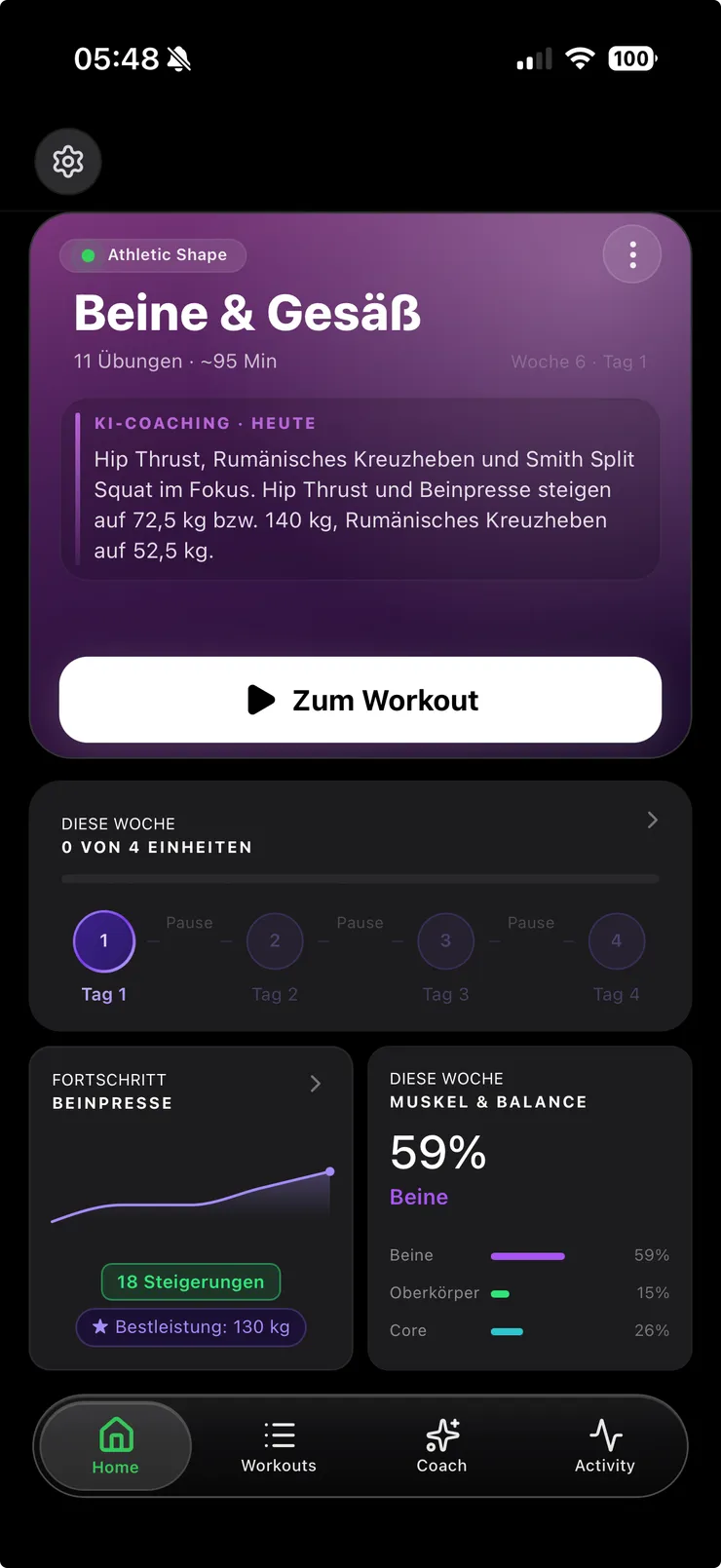
OUR APPROACH AT 10 REPSAt 10 Reps, this trade-off is already baked into every workout. Sessions are built around 4 to 6 deliberately chosen exercises that together cover the needed volume per muscle group - you don't have to judge yourself whether another exercise would help or just add fatigue.
The ProgressionEngine also makes sure the sets you do actually count.
Conclusion: Fewer, but right
The number of exercises is a means, not a goal in itself.
Once you know how many sets a muscle group actually needs per week, you land almost automatically on a manageable number of exercises per session - usually far fewer than most people assume.
Continue reading


Knowledge is the start.
The plan does the rest.
Everything we write about here — progression, recovery, structure — is built right into the app. 5 questions, and your first plan is ready.
Download on theApp Store