Free Weights vs. Machines - No Either-Or
Free weights are seen as the "real" form of strength training. Machines as a beginner's tool, or a fallback when the rack is taken.
 10 Reps Editorial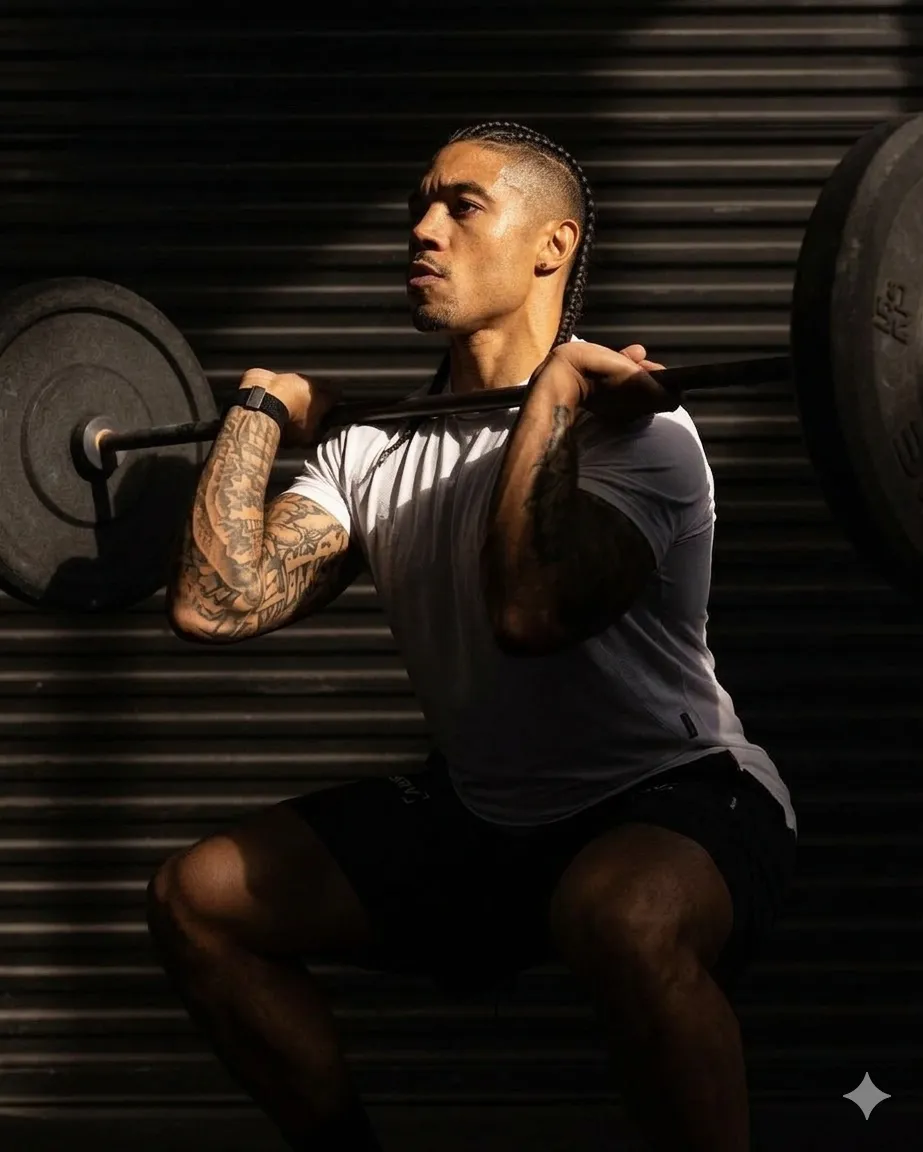
Free weights are seen as the "real" form of strength training. Machines as a beginner's tool, or a fallback when the rack is taken.
That hierarchy is stubborn — and still wrong. Both have their place. The question isn't which tool is better, but what it's used for.
The old debate — and why it misses the point
Treating "free weights vs. machines" as an either-or mixes up tool and goal. Both training forms create a stimulus for the muscle — just in different ways, with different trade-offs.
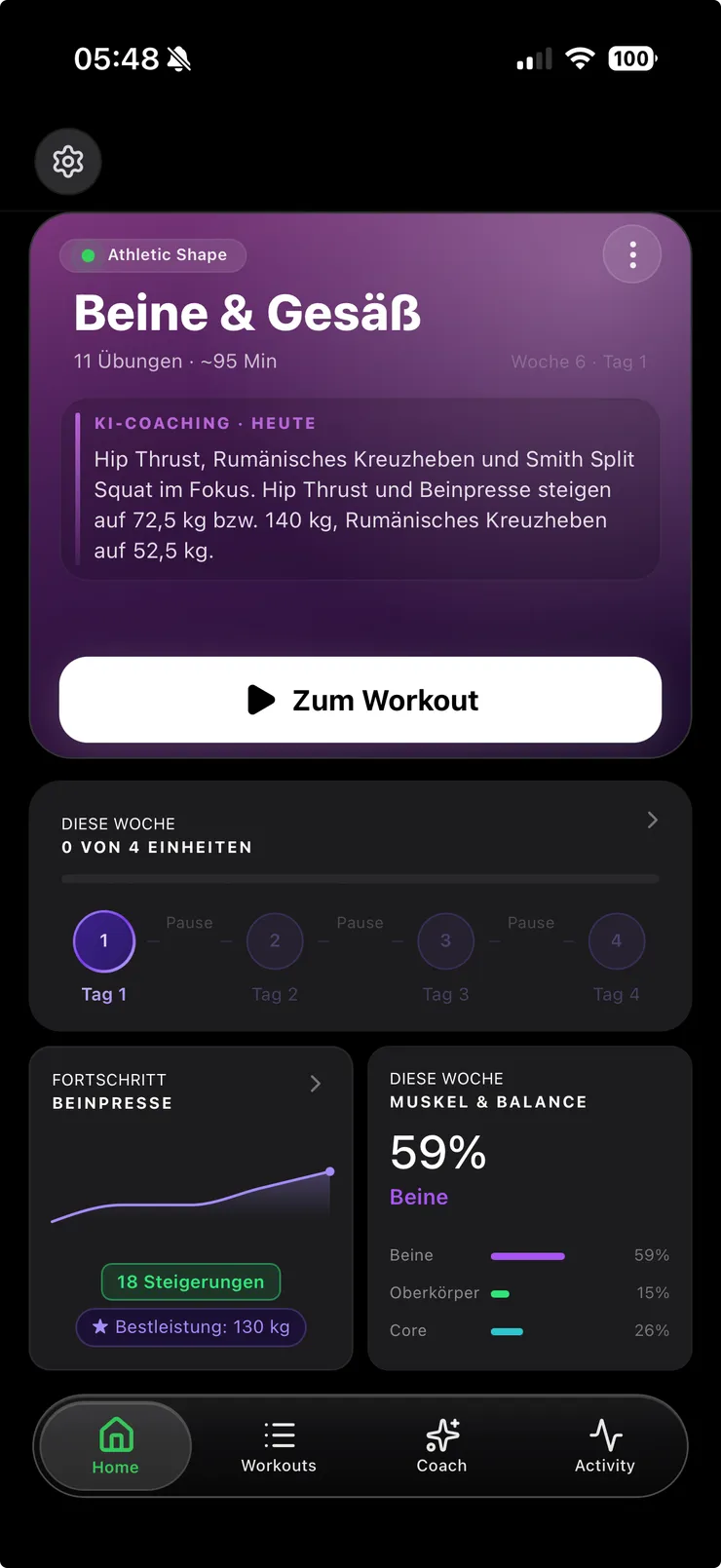
That's why both show up in the same plan in the 10 Reps app. Not as a compromise, but because each has its own job.
What free weights do
Free weights like barbells and dumbbells require the body to stabilize the movement itself. There's no guide rail — balance, coordination, and core stability are part of the exercise.
One data point: a small study comparing the free-weight squat to the Smith machine squat found average muscle activation across all measured muscles was 43% higher for the free-weight squat, particularly in the calves, hamstrings, and the inner portion of the quadriceps (vastus medialis). [1]
Worth noting: the study had only 6 participants, measured a single training session, and compared specifically against the Smith machine — a guided barbell, not machines like the leg press or cable pulley. Higher muscle activation is also a proxy measure, not direct proof of more muscle growth. The direction of the effect matches what many athletes experience in training — but it doesn't hold up as hard proof that "free weights build more muscle."
The downside of free weights is obvious: more technical demand, more coordination required. Conventional training wisdom holds that poor form or high fatigue matters more with free weights than on a machine — though there's no solid comparative injury data to back that up.
What machines do
Machines guide the movement along a fixed path. That takes the stabilization work off the body — and that's exactly their biggest advantage.
If you want to train to true muscular failure, you can do it on a machine with less technical risk than with a barbell overhead or on your back — the path is fixed, so losing control under load is less likely. That's training-practice logic too, not the result of an injury study.
Machines are also well suited for isolating individual muscles — for example with muscular imbalances or in rehab after an injury. And they lower the entry barrier: if you're new to strength training, a machine lets you learn movement patterns and load without mastering complex technique at the same time.
That's why machine exercises show up in the 10 Reps app specifically where isolation or a safe final rep matter more than stabilization work.
What the research on muscle growth actually shows
The most comprehensive meta-analysis on this topic to date evaluated 13 studies with over 1,000 participants. Result: at equal training volume, there's no significant difference in muscle growth between free weights and machines. [2]
Context matters here: within the meta-analysis, this conclusion rests on just 5 individual hypertrophy studies — a narrower evidence base than the clear-cut wording suggests. Still, as a cautious trend, it's the best data currently available.
Strength gains told a different story — a specificity effect showed up. People who trained with free weights improved demonstrably more in free-weight lifts. The reverse trend — greater machine-strength gains from machine training — appeared in the same analysis but wasn't statistically significant. So strength doesn't automatically transfer from one form to the other — that's clearly shown for transfer toward free weights, more of a trend in the other direction.
For pure muscle growth, the choice of tool is secondary. For the kind of strength you actually need in the end, it isn't.
Where free weights have the edge
Free weights pay off especially where strength needs to transfer: in daily life, in sport, in movements that don't happen on a fixed rail. That's why compound lifts like the squat, deadlift, and bench press form the foundation of most 10 Reps plans — especially at the start of a session, when focus and strength are at their highest.
Where machines have the edge
Machines play to their strength when safety, isolation, or time efficiency matter: at the end of a session, when fatigue is high and free-weight technique would suffer. Or specifically for muscle groups that are hard to isolate with free exercises.
The combination that actually makes sense
The obvious strategy, then, isn't picking a side — it's sequencing: compound lifts with free weights at the start of a session, when technique and the nervous system are freshest. Machines toward the end, when isolation and a safe final rep matter more than stabilization work.
That's exactly the principle the training plans in the 10 Reps app are built on.
OUR APPROACH AT 10 REPSAt 10 Reps, choosing between free weights and machines isn't a matter of belief.
The system uses free compound lifts where stability and transferability matter — and machines where isolation and safe failure training pay off more. Both belong to the same plan, not two separate camps.
Conclusion: Two Tools, One Goal
Free weights and machines aren't a contradiction. For muscle growth, both deliver comparable results at equal volume — though on a still-narrow evidence base. For transferable strength, free weights have the edge. For safe isolation and training to failure, machines do.
The question is never which is better — it's what you're using it for.
- 1.Schwanbeck S, Chilibeck PD, Binsted G. "A comparison of free weight squat to Smith machine squat using electromyography." Journal of Strength and Conditioning Research, 2009;23(9):2588–2591.
- 2.Haugen ME, Vårvik FT, Larsen S, Haugen AS, van den Tillaar R, Bjørnsen T. "Effect of free-weight vs. machine-based strength training on maximal strength, hypertrophy and jump performance – a systematic review and meta-analysis." BMC Sports Science, Medicine and Rehabilitation, 2023;15:113.
Continue reading
Knowledge is the start.
The plan does the rest.
Everything we write about here — progression, recovery, structure — is built right into the app. 5 questions, and your first plan is ready.
Download on theApp Store