Incline Bench Press: Which Angle Really Targets the Upper Chest
Which bench angle is right for the upper chest is debated more heatedly than the evidence warrants. Here's how to do the incline press - and what the research actually shows.
 10 Reps Editorial
While the flat bench press mainly loads the middle and lower part of the chest, the incline press from our overview article "The 5 Best Chest Exercises" shifts the focus toward the upper chest. Which bench angle is really the right one for that is debated in fitness forums more heatedly than the evidence warrants. Here we go deeper: the correct form with dumbbells, what research actually shows about bench angle - and which mistakes cost you the effect.
- 1Starting position:
Set the incline bench to about 30 degrees, lie back, hold the dumbbells at shoulder height. Shoulder blades pulled together, feet planted firmly on the floor.
1Starting position: Set the incline bench to about 30 degrees, lie back, hold the dumbbells at shoulder height. Shoulder blades pulled together, feet planted firmly on the floor. - 2Upward movement:
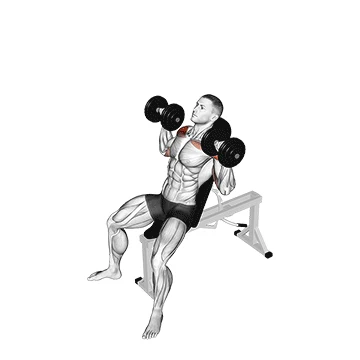
Press the dumbbells up from shoulder height until your arms are almost straight. Don't let your elbows flare out too far.
2Upward movement: Press the dumbbells up from shoulder height until your arms are almost straight. Don't let your elbows flare out too far. - 3Brief tension phase at the top:
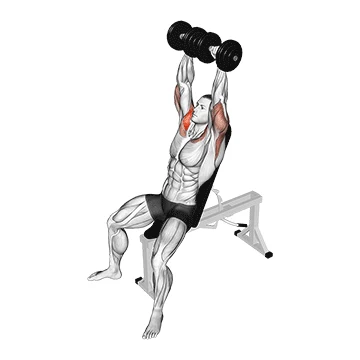
Hold briefly, without letting the dumbbells clang together at the top.
3Brief tension phase at the top: Hold briefly, without letting the dumbbells clang together at the top. - 4Downward movement:
Lower under control back to shoulder height - a noticeable stretch in the upper chest at the bottom is normal.
4Downward movement: Lower under control back to shoulder height - a noticeable stretch in the upper chest at the bottom is normal. - 5Breathing:
Exhale as you press up, inhale as you lower.
5Breathing: Exhale as you press up, inhale as you lower.
Why this exercise is so effective - and what bench angle really does
As the bench angle increases, emphasis shifts toward the upper chest (the clavicular head of the pectoralis major), while the middle and lower chest work less than in the flat bench press. Less clear-cut is the question of which angle is best suited for it.
A frequently cited EMG study (Rodríguez-Ridao et al., 2020, published in the International Journal of Environmental Research and Public Health) looked at exactly that: 30 trained young adults performed the barbell bench press at five bench inclinations - 0°, 15°, 30°, 45° and 60° - and the muscle activity of the chest portions, the front shoulder and the triceps was measured.
The practical takeaway: an angle around 30° is a sensible starting point for focusing on the upper chest - but the data don't yield an exact "ideal angle," since the differences between 0° and 45° were not significant for the upper chest. Two caveats belong here: what was measured was muscle activity, not muscle growth - and the study used a barbell, so the transfer to dumbbells is plausible but not directly shown. If you set the bench much steeper (from about 45°), you increasingly train the front shoulder instead of specifically the upper chest.
Common mistakes
Variations
Sets and reps
For the incline press, a range of around 3-4 sets of 8-12 reps has become established in training practice, with 1-3 reps left in reserve at the end of each set (RIR 1-3). This, too, is a general guideline, not a rigid rule.
OUR APPROACH AT 10 REPSIn the 10 Reps app, the incline press is part of several training plans, including push and upper-body focused programs. The ProgressionEngine doesn't lock weight and reps in place - it adjusts them based on your feedback from the last session. Train consistently and cleanly, and the load goes up; need more recovery, and you get it, without the plan grinding to a halt.
Built-in deload weeks also make sure load gets reduced automatically on a regular basis, so you don't have to keep track of that yourself.
Conclusion
The ideal angle for the upper chest is less an exact number than a range: 30° is a good, well-studied starting point, and from about 45° the shoulder increasingly takes over.
More decisive than a few degrees either way are fixed shoulder blades and controlled elbows.
Part of our chest-exercises series - discover more essential chest exercises here: The 5 Best Chest Exercises.
Continue reading
Knowledge is the start.
The plan does the rest.
Everything we write about here — progression, recovery, structure — is built right into the app. 5 questions, and your first plan is ready.