Leg Press: When the Machine Is the Better Choice Than the Squat
The leg press is more than a fallback for the squat. Here's how to do it correctly, when the machine is the better choice, and which mistakes cost the most.
 10 Reps Editorial
In our overview article "The 8 Best Leg Exercises for Stronger Legs" the leg press is described as an alternative to the squat when your back or balance make a free barbell exercise difficult - a comparison that deserves more than a side note. We've already covered the free version in depth in our Goblet Squat article. Here we get to the bottom of the leg press: how do you perform it correctly, when is the machine actually the better choice - and which mistakes cost you effect or put unnecessary strain on your lower back?
- 1Starting position:
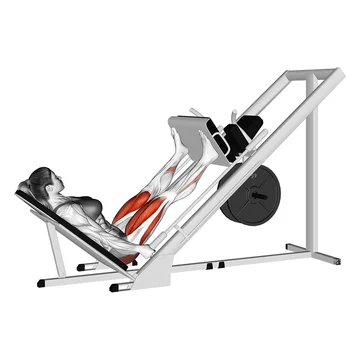
Sit down on the leg press, back and lower back flat against the padding. Place your feet shoulder-width apart on the footplate, knees pointing in the direction of your toes.
1Starting position: Sit down on the leg press, back and lower back flat against the padding. Place your feet shoulder-width apart on the footplate, knees pointing in the direction of your toes. - 2Downward movement:
Lower the weight under control into a deep squat position - without your lower back lifting off the padding.
2Downward movement: Lower the weight under control into a deep squat position - without your lower back lifting off the padding. - 3Bottom position:
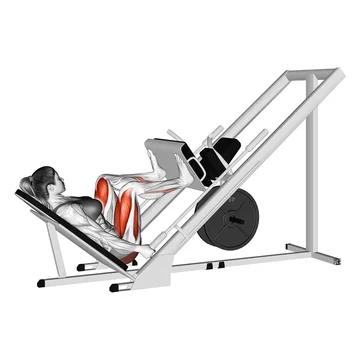
Brief control, your knees stay stable in line with your toes and don't cave inward.
3Bottom position: Brief control, your knees stay stable in line with your toes and don't cave inward. - 4Upward movement:
Actively push through your heels and extend your legs, without locking your knees out hard at the top.
4Upward movement: Actively push through your heels and extend your legs, without locking your knees out hard at the top. - 5Breathing:
Inhale as you lower, exhale as you press up.
5Breathing: Inhale as you lower, exhale as you press up.
Your lower back is the most important indicator of the right depth: as long as it stays flat against the padding, the range of motion is well matched to your current mobility.
Why this exercise is so effective - and when it sensibly replaces the squat
The leg press primarily works the front of the thigh (quadriceps); with sufficient depth, the hamstrings and glutes assist.
Three reasons the leg press is a sensible alternative or addition to the squat:
That doesn't mean the leg press fundamentally replaces the squat: the squat additionally trains core and stabilizing muscles that the guided machine hardly demands. For everyday, functional strength the free version stays valuable - for targeted leg muscle building without additional stabilization demands, the leg press is a full-fledged alternative. You know the principle from the chest press machine: the machine takes over stabilization and makes the load on the target muscle more predictable.
Common mistakes
Variations
Sets and reps
As a machine exercise, the leg press is often programmed in a range of 3-4 sets of 10-15 reps, with 1-2 reps left in reserve at the end of each set (RIR 1-2) - in the last set of a session, much like the chest press, you can also train closer to failure. This, too, is a general guideline, not a rigid rule.
OUR APPROACH AT 10 REPSIn the 10 Reps app, the leg press is part of several training plans, including lower-body focused programs. The ProgressionEngine doesn't lock weight and reps in place - it adjusts them based on your feedback from the last session. Train consistently and cleanly, and the load goes up; need more recovery, and you get it, without the plan grinding to a halt.
Built-in deload weeks also make sure load gets reduced automatically on a regular basis, so you don't have to keep track of that yourself.
Conclusion
The leg press isn't a compromise compared with the squat but an exercise with its own advantage: because the stabilization work drops out, the front of the thigh can be loaded more specifically and often with more weight - especially valuable when your back or balance make the free version difficult.
Your lower back against the padding remains the most important gauge for correct form.
Part of our leg-exercises series - discover more essential leg exercises here: The 8 Best Leg Exercises for Stronger Legs.
Continue reading
Knowledge is the start.
The plan does the rest.
Everything we write about here — progression, recovery, structure — is built right into the app. 5 questions, and your first plan is ready.