Mobility Training - Why Flexibility Doesn't Rule Out Strength Training
Many lifters think in either-or terms: either you train for strength, or you work on mobility.
 10 Reps Editorial
Many lifters think in either-or terms: either you train for strength, or you work on mobility. Lift heavy and you supposedly shouldn't stretch, or you'll go "soft."
That divide is stubborn — and simply doesn't hold up scientifically.
Where the myth comes from
The myth has a kernel of truth that got blown out of proportion. Studies do show that long static stretching right before a maximal strength effort can reduce performance — the so-called stretch-induced force deficit. But duration is what matters: only stretch holds well over 60 seconds per muscle group show a meaningful strength loss. Short static stretches under that mark, embedded in a full warm-up with actual warm-up activity, barely register.
So the problem was never mobility itself — it was one very specific situation: long, isolated holds right before a maximal attempt. That single study condition got generalized into the blanket rule "stretching makes you weak," and that's simply not accurate.
What mobility training actually means
Mobility isn't the same as classic, passive stretching. Where static stretching passively holds an end position, mobility training moves actively and under control through the available range of motion — closer to what a joint actually needs to do during training.
One notable finding sits inside strength training itself: people who consistently train through a full range of motion measurably improve their mobility — to a degree comparable with dedicated stretching programs. Properly executed strength training is, in itself, a piece of mobility training. Anyone training only through a partial range of motion is giving up exactly that side benefit.
Timing decides, not the exercise
Whether mobility work supports or blunts strength performance comes down almost entirely to timing.
Before training: Dynamic mobility drills — active movement through the range of motion instead of held positions — prime joints and the nervous system specifically. They measurably increase jump and explosive-strength performance compared to no warm-up or a purely static one, and don't impair the strength work that follows.
During training: Full range of motion on the actual exercises does double duty — building strength and preserving mobility in the same movement.
After training: This is exactly where longer static stretching belongs. With no maximal effort coming up, the risk of strength loss disappears entirely, while the mobility gains stick around.
Mobility isn't a competitor to strength training, then — it's a question of where it sits in the session.
What this means for your training
OUR APPROACH AT 10 REPSAt 10 Reps, mobility isn't a separate to-do you have to schedule yourself.
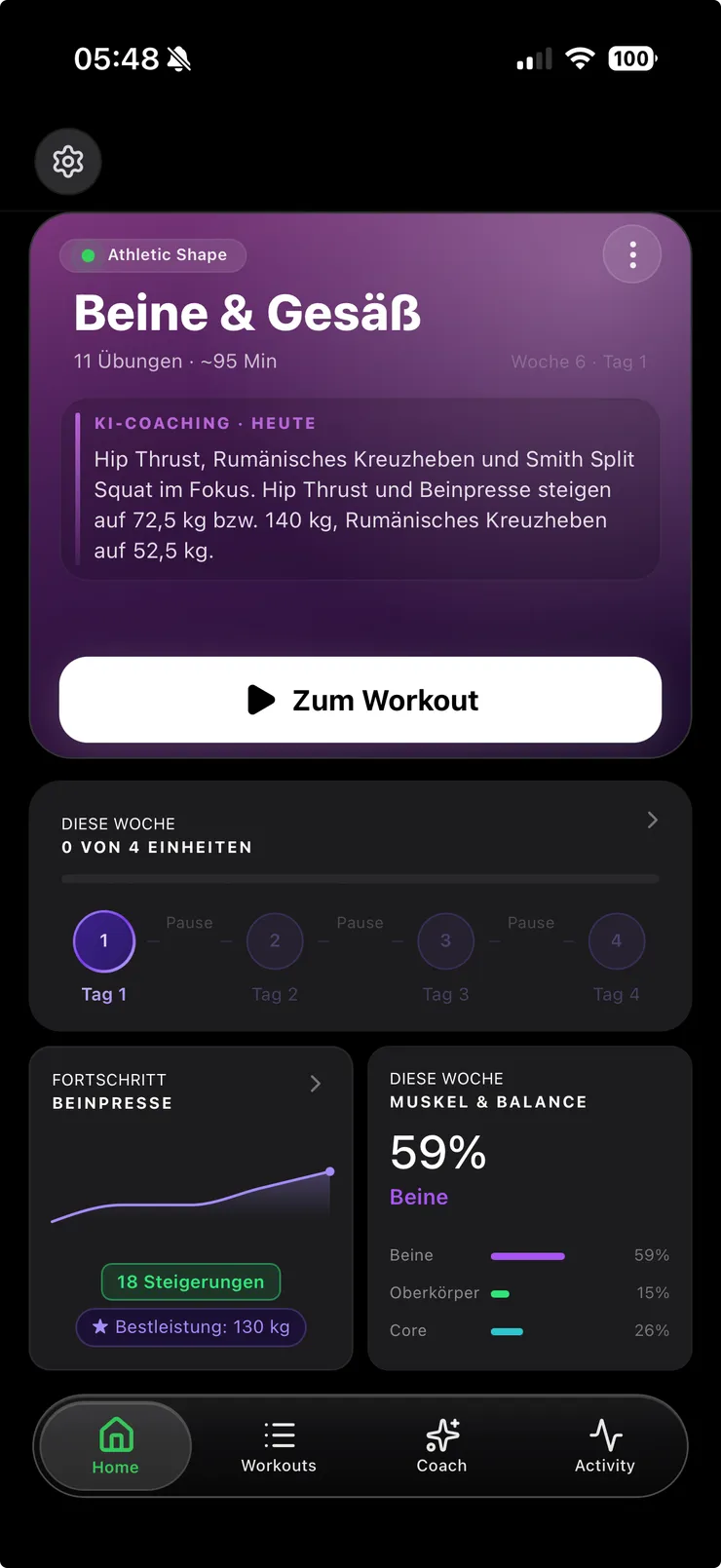
Every workout starts with a fixed warm-up block: first a short general activation like a treadmill walk, then a dynamic mobility block with active movement through the range of motion — no long, held stretch positions. Exactly the sequence research also describes as effective.
Conclusion: Strength and Mobility Aren't Opposites
The idea that strength training and mobility work are opposites doesn't hold up to closer scrutiny. Used correctly, they complement each other — dynamic before training, full range of motion during training, static afterward.
Get this right, and you never have to choose between strong and mobile.
- 1.Alizadeh S, Daneshjoo A, Zahiri A, Anvar SH, Goudini R, Hicks JP, et al. "Resistance Training Induces Improvements in Range of Motion: A Systematic Review and Meta-Analysis." Sports Medicine, 2023.
- 2.Behm DG, Alizadeh S, Hadjizadeh Anvar S, Mahmoud MMI, Ramsay E, Hanlon C, Cheatham S. "Revisiting the stretch-induced force deficit: A systematic review with multilevel meta-analysis of acute effects." Journal of Sport and Health Science, 2024.
- 3.Chaouachi A, Castagna C, Chtara M, et al. "Effect of warm-ups involving static or dynamic stretching on agility, sprinting, and jumping performance in trained individuals." Journal of Strength and Conditioning Research, 2010;24(8):2001–2011.
- 4."Systematic review and network meta-analysis of the effects of different warm-up methods on acute lower limb explosive strength." BMC Sports Science, Medicine and Rehabilitation, 2023.
- 5.Opplert J, Babault N. "Acute Effects of Static Stretching on Muscle Strength and Power: An Attempt to Clarify Previous Caveats." Frontiers in Physiology, 2018.
- 6.Behm DG, Chaouachi A. "A review of the acute effects of static and dynamic stretching on performance." European Journal of Applied Physiology, 2011;111(11):2633–2651.
Continue reading


Knowledge is the start.
The plan does the rest.
Everything we write about here — progression, recovery, structure — is built right into the app. 5 questions, and your first plan is ready.
Download on theApp Store