Muscle Soreness: What It Really Says About Your Training
No soreness, no good workout — that idea runs deep. Many people treat leg pain the day after training as proof the session paid off.
 10 Reps Editorial
No soreness, no good workout — that idea runs deep. Many people treat leg pain the day after training as proof the session paid off.
Research paints a clearly different picture.
What actually happens in the muscle
Muscle soreness comes from small structural damage in the muscle fibers, triggered mainly by unfamiliar or eccentrically emphasized load — movements where the muscle lengthens under tension, like lowering a weight. This micro-damage is followed by a local inflammatory response, which is what actually causes the pain. Typically the ache starts 12 to 24 hours after training, peaks between 24 and 72 hours later, and fades within 5 to 7 days.
One myth can be put to rest for good: lactic acid has nothing to do with it. Lactate clears from the body within about an hour after training — long before soreness even sets in.
Why soreness isn't proof of growth
This is the key point: muscle damage is one possible growth stimulus among several, but soreness isn't a reliable indicator of how much of that actually happened. A widely cited review on the topic reaches a clear conclusion: soreness correlates only weakly with direct damage markers like strength loss, creatine kinase levels, or MRI findings — making it unreliable as a measure of muscular adaptation.
A second piece of evidence comes from training practice itself: in a well-known longitudinal study, muscle damage in trained lifters dropped markedly as training continued — but muscle growth kept going undiminished. Soreness fades over time. Growth doesn't.
The comparison between muscle groups fits the same picture: some muscles — hamstrings, for instance — get noticeably sorer than others, like the shoulders. Yet both groups grow comparably well with appropriate training. And soreness also shows up after activities that trigger essentially no meaningful muscle growth at all, like a long run.
What soreness actually shows
If not growth, then what? Mainly one thing: novelty. A new movement pattern, an unfamiliar depth of range of motion, a sudden jump in training volume, or a lot of eccentrically emphasized reps — all of that raises the odds of soreness, regardless of whether the session was actually more effective than usual.
With repeated exposure to the same movement, the response noticeably fades — the so-called repeated bout effect. The body adapts to that specific type of stimulus and responds next time with less damage and less pain, even though the training stays identical in volume and intensity. So training the same exercises regularly means you'll almost inevitably get sore less often — a sign of adaptation, not of stalling.
What this means for your training
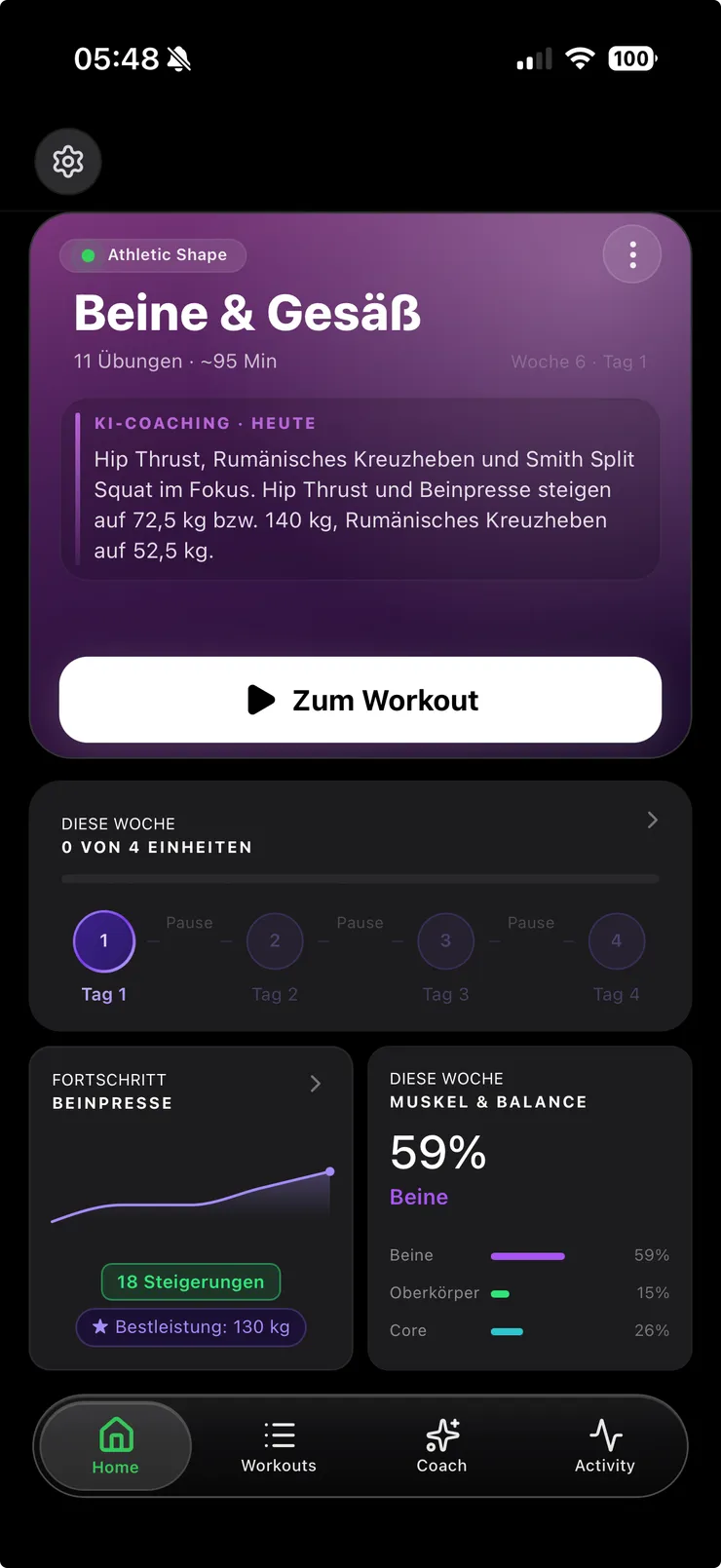
OUR APPROACH AT 10 REPSAt 10 Reps, progress isn't measured by soreness — it's measured by real training data.
After every set, you give feedback — too light, just right, too heavy — and the app adjusts your next weight recommendation accordingly. The exercise detail also shows you the complete weight history for every exercise over time. That way it stays visible whether you're actually getting stronger, regardless of how you feel the next day.
Conclusion: Soreness Is a Side Effect, Not a Scoreboard
Muscle soreness is a normal side effect of training, but not proof of its quality. It mainly tells you something about novelty and habituation — not about how much muscle you actually built.
If you're chasing progress, look at the numbers, not the pain.
- 1.Schoenfeld BJ, Contreras B. "Is Postexercise Muscle Soreness a Valid Indicator of Muscular Adaptations?" Strength and Conditioning Journal, 2013;35(5):16–21.
- 2.Damas F, Phillips SM, Libardi CA, et al. "Resistance training-induced changes in integrated myofibrillar protein synthesis are related to hypertrophy only after attenuation of muscle damage." The Journal of Physiology, 2016;594(18):5209–5222.
- 3.Schoenfeld BJ. "Does exercise-induced muscle damage play a role in skeletal muscle hypertrophy?" Journal of Strength and Conditioning Research, 2012;26(5):1441–1453.
- 4.Cheung K, Hume PA, Maxwell L. "Delayed onset muscle soreness: treatment strategies and performance factors." Sports Medicine, 2003;33(2):145–164.
- 5.McHugh MP. "Recent advances in the understanding of the repeated bout effect: the protective effect against muscle damage from a single bout of eccentric exercise." Scandinavian Journal of Medicine & Science in Sports, 2003;13(2):88–97.
- 6.Sikorski EM, Wilson JM, Lowery RP, Joy JM, Laurent CM, Wilson SM-C, Hesson D, Naimo MA, Averbuch B, Gilchrist P. "Changes in perceived recovery status scale following high volume, muscle damaging resistance exercise." Journal of Strength and Conditioning Research, 2013;27(8):2079–2085.
Continue reading


Knowledge is the start.
The plan does the rest.
Everything we write about here — progression, recovery, structure — is built right into the app. 5 questions, and your first plan is ready.
Download on theApp Store