Sleep and Strength Training - The Overlooked Lever for Progress
The training plan is set, protein is dialed in, sets are logged carefully - and yet progress still lags behind expectations.
 10 Reps Editorial
- 1In men, roughly 70 percent of daily growth hormone release happens during sleep - a large part of actual training adaptation happens during sleep, not in the gym.
- 2A single night of total sleep deprivation lowers muscle protein synthesis by 18 percent, raises cortisol by 21 percent, and lowers testosterone by 24 percent.
- 3One week of only five hours of sleep per night lowers testosterone to a degree the study's lead researcher compared to ten to fifteen years of normal aging.
The training plan is set, protein is dialed in, sets are logged carefully - and yet progress still lags behind expectations. The most overlooked factor is rarely training design itself, but what happens afterward: sleep.
What sleep actually does for your training
A large share of the body's own growth hormone release is tightly coupled to deep sleep - in men, roughly 70 percent of daily output occurs during sleep, while in women secretion is spread more evenly across the day. Regardless of that difference, the same holds true for both: training provides the stimulus, but a large part of the actual adaptation - muscle growth, strength gains, nervous system recovery - happens during sleep, not in the gym.
What measurably happens without enough sleep
The data on this is clearer than many expect. A single night of total sleep deprivation lowers muscle protein synthesis the next day by 18 percent, raises the stress hormone cortisol by 21 percent, and lowers testosterone by 24 percent - a clear shift toward a catabolic, muscle-breakdown-favoring state, triggered by just one bad night.
With repeated sleep loss, the effect becomes even more drastic: one week of only five hours of sleep per night significantly lowers testosterone levels in young, healthy men - the study's lead researcher herself described the magnitude as comparable to the decline you'd otherwise expect from ten to fifteen years of normal aging. That's not a minor side effect - it's a hormonal shift on a scale that would otherwise take decades to occur.
The effect compounds
Anyone who thinks a single bad night can easily be shaken off is largely right - the real problem starts once sleep loss becomes a permanent state. Chronically short sleep demonstrably blocks strength and muscle-building adaptations over weeks and months, not just on the days that follow. The training stimulus stays the same - but the body can no longer fully convert it into progress.
What this means for your practice
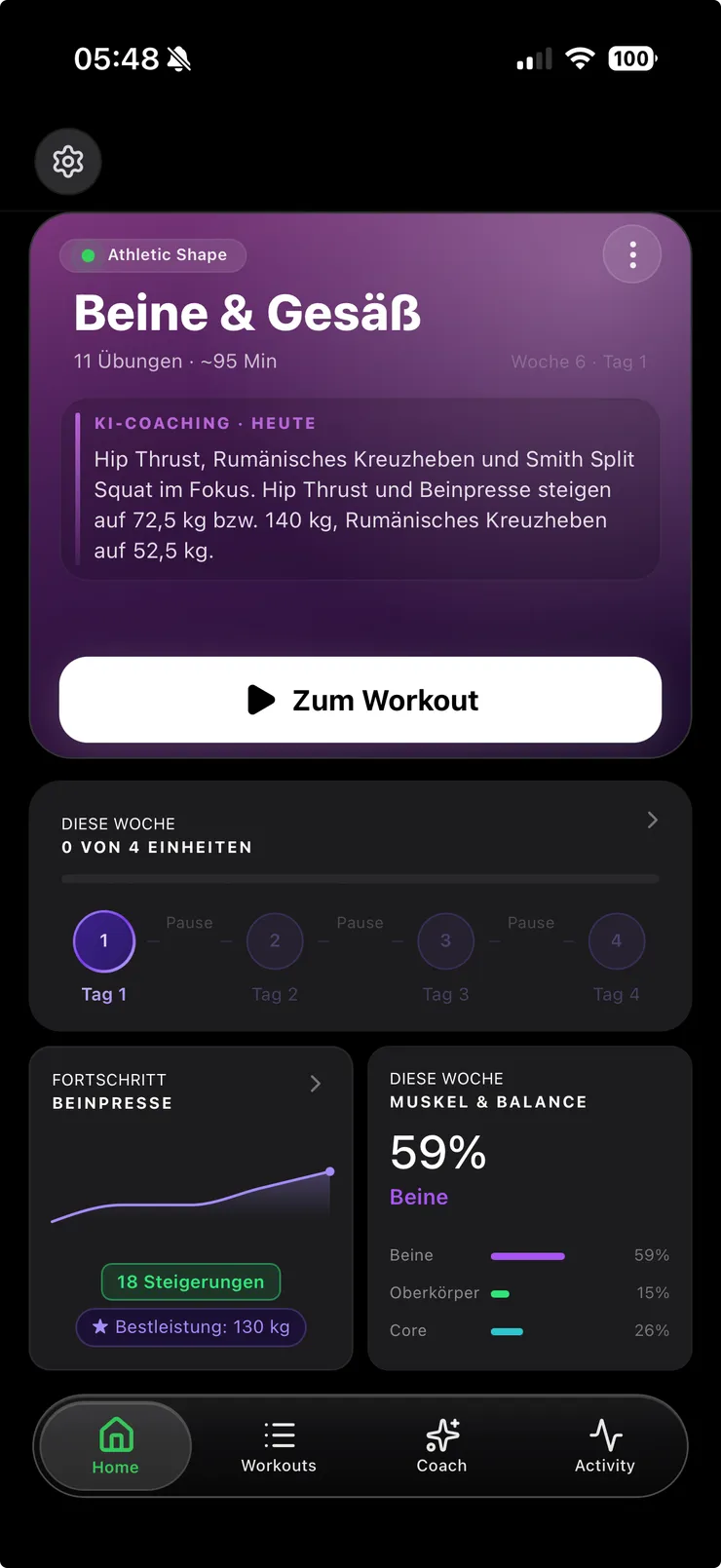
OUR APPROACH AT 10 REPS10 Reps doesn't track sleep - that's deliberate, similar to how we handle nutrition. What the app takes care of instead is making sure recovery is built into the training itself. Every multi-week plan includes a fixed deload phase with reduced volume, and the ProgressionEngine adjusts load so training never escalates at the expense of recovery.
What happens during sleep stays your responsibility - making sure training fits around it is what 10 Reps takes care of.
Conclusion: The lever that matters alongside training
Sleep isn't a soft wellness factor - it's a direct, hormonally measurable driver of strength and muscle growth. Anyone who has training, nutrition, and progression dialed in but skimps on sleep is holding themselves back at a point that stays invisible in the gym - but is exactly where real progress is made.
No training plan can outperform the sleep behind it.
Continue reading
Knowledge is the start.
The plan does the rest.
Everything we write about here — progression, recovery, structure — is built right into the app. 5 questions, and your first plan is ready.
Download on theApp Store