Strength Loss During a Training Break - What Actually Happens
A vacation, a cold, a few stressful weeks at work — and the thought creeps in: "I'm starting from zero again." That's not true.
 10 Reps Editorial
A vacation, a cold, a few stressful weeks at work — and the thought creeps in: "I'm starting from zero again." That's not true.
Strength is one of the most resilient abilities the body builds, and it doesn't disappear nearly as fast as most people think.
Why strength behaves differently than endurance
Not every ability fades at the same rate during a break. Endurance is sensitive to stopping training — noticeable losses show up after just a few weeks without a stimulus. Maximal strength, on the other hand, depends heavily on neural adaptations: how efficiently the nervous system recruits and drives muscle fibers. Those neural pathways break down far more slowly than cardiovascular capacity does.
The result: if you take a break, you lose conditioning first — not strength.
The first few weeks: barely any change
In the first one to two weeks without training, almost nothing happens to maximal strength. Muscle mass and strength levels stay stable for most people in this window, even with a complete training break. Only after that does the picture start to shift.
When it actually becomes measurable
Starting around week three or four without a stimulus, the first declines show up — especially in recently achieved personal bests and in explosive, sport-specific strength. People who've trained for years lose strength more slowly than someone who's only been at it for a few months. The reason is simple: more experienced lifters have a bigger buffer above their untrained baseline.
Even over much longer breaks of several months, a substantial share of previously gained strength remains, compared to completely untrained people. Strength is rarely lost — it just fades more slowly.
Why starting again never means starting from zero
The second piece of good news: rebuilding after a break is measurably faster than the original buildup. Part of what drives this is what researchers call muscle memory. During strength training, additional cell nuclei migrate into muscle fibers and support protein synthesis there. Those nuclei stick around even when the muscle fiber shrinks a bit from inactivity — and that's why the body responds faster the second time around.
A significant part of this effect runs through the nervous system: movement patterns that were once trained are recalled faster than they were originally learned.
That explains a feeling many people know from experience: after a longer break, the first weeks back often feel surprisingly easy. The old weights come back within reach faster than they took to reach the first time around.
What this means for your training
OUR APPROACH AT 10 REPSAt 10 Reps, nothing gets lost during a break.
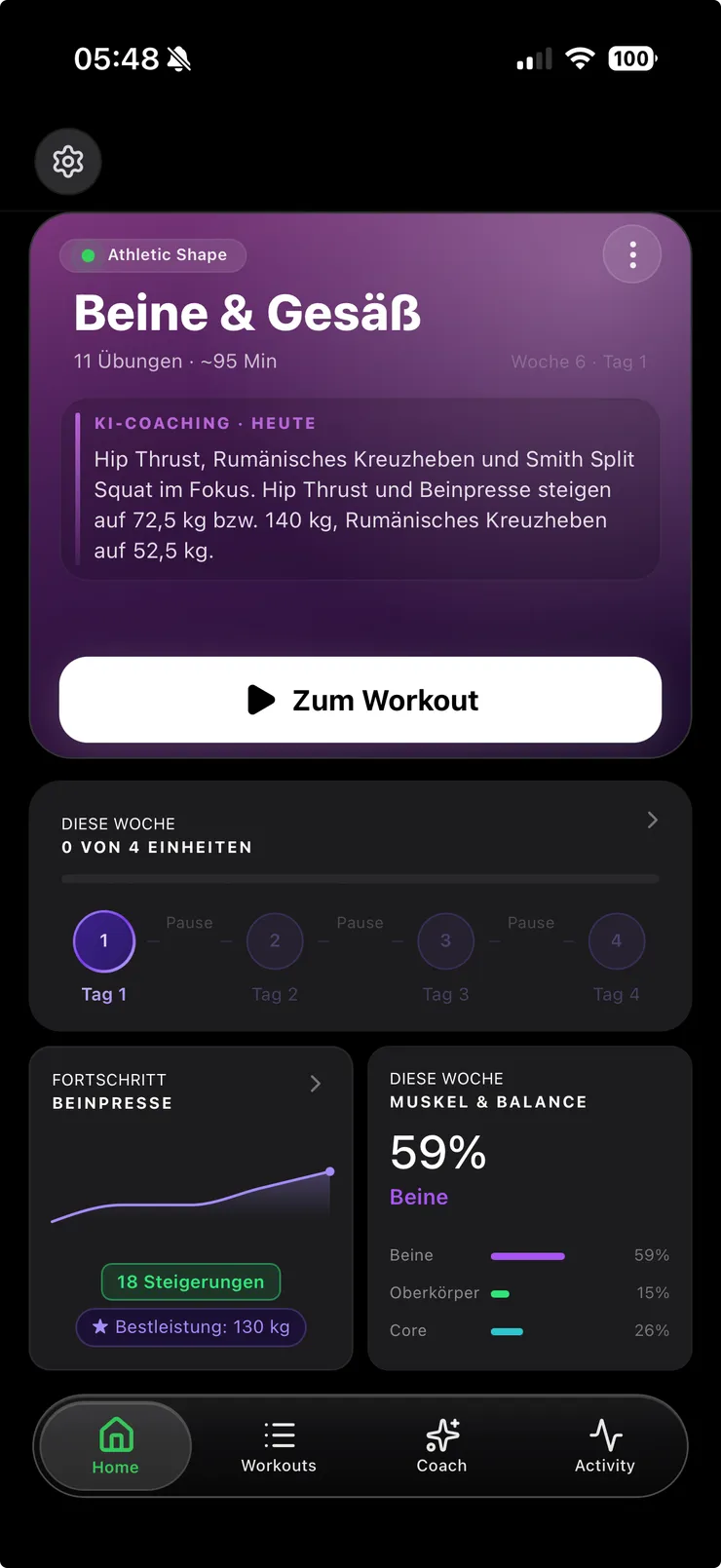
The exercise detail keeps the complete weight history visible — including the weeks before the break. The AI coach places your first session back in realistic context instead of comparing it directly to your last personal best, and adjusts its recommendation accordingly instead of pushing you straight back to your old weights.
Conclusion: A Break Isn't a Reset
Losing strength feels far more dramatic in your head than your body actually allows. Once you know what really happens in the first weeks of a break, there's no need to treat time off as a setback.
It's an interruption — not a restart.
Continue reading


Knowledge is the start.
The plan does the rest.
Everything we write about here — progression, recovery, structure — is built right into the app. 5 questions, and your first plan is ready.
Download on theApp Store