Calf Raise: Full Range of Motion Makes the Difference
Calves often respond sluggishly to training - and short bouncing reps make it worse. Here's how to get far more out of every rep with the standing calf raise.
 10 Reps Editorial
Your calves are under constant load in everyday life - walking, standing, climbing stairs - which is exactly why they often respond sluggishly to targeted training. We already introduced the standing calf raise briefly in our overview article "The 8 Best Leg Exercises for Stronger Legs". Here we go deeper: how do you perform the exercise correctly, why does range of motion decide success here in particular - and which mistakes cost you the most effect?
- 1Starting position:
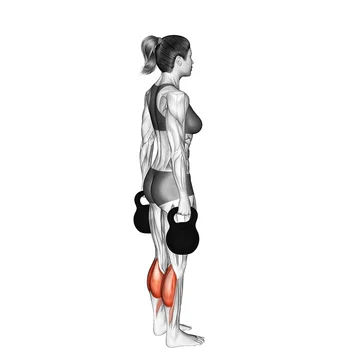
Place the ball of your foot on a raised surface (step, weight plate, or a dedicated calf machine) with your heel hanging freely. Without a raised surface it also works on flat ground, as in the animation - the stretch at the bottom is just smaller.
1Starting position: Place the ball of your foot on a raised surface (step, weight plate, or a dedicated calf machine) with your heel hanging freely. Without a raised surface it also works on flat ground, as in the animation - the stretch at the bottom is just smaller. - 2Downward movement:
Lower your heels under control until you feel a clear stretch in the lower calf.
2Downward movement: Lower your heels under control until you feel a clear stretch in the lower calf. - 3Upward movement:
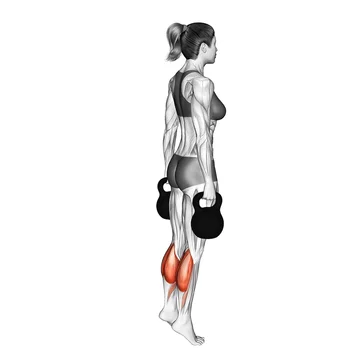
Actively push up onto your toes - as high as possible, until your calf is maximally contracted at the top.
3Upward movement: Actively push up onto your toes - as high as possible, until your calf is maximally contracted at the top. - 4Brief pause at the top:
Hold the maximum contraction briefly before reversing the movement.
4Brief pause at the top: Hold the maximum contraction briefly before reversing the movement. - 5Breathing:
Exhale as you push up, inhale as you lower.
5Breathing: Exhale as you push up, inhale as you lower.
Full range of motion matters here more than for almost any other exercise: if you only bounce through the short upper portion, you use a fraction of the possible training stimulus.
Why this exercise is so effective
The standing calf raise primarily works the superficial calf muscle (gastrocnemius). This muscle crosses two joints - the knee and the ankle - and therefore produces its full force especially with the knee straight, as is the case in the standing version.
Three reasons full range of motion matters so much here:
Common mistakes
Variations
Sets and reps
Because the calf muscles are used to many small, recurring loads in everyday life, they're often programmed in training practice with a somewhat higher rep range than other muscle groups - around 3-4 sets of 12-20 reps is typical, with 1-2 reps left in reserve at the end of each set (RIR 1-2). This, too, is a general guideline, not a rigid rule.
OUR APPROACH AT 10 REPSIn the 10 Reps app, the calf raise is part of several training plans, including lower-body focused programs. The ProgressionEngine doesn't lock weight and reps in place - it adjusts them based on your feedback from the last session. Train consistently and cleanly, and the load goes up; need more recovery, and you get it, without the plan grinding to a halt.
Built-in deload weeks also make sure load gets reduced automatically on a regular basis, so you don't have to keep track of that yourself.
Conclusion
With the calf raise, success isn't decided by the weight on the machine but by the range of motion you consistently use - a noticeable stretch at the bottom, full contraction at the top.
Pay attention to that and you'll get far more out of the exercise than from the short bouncing reps most often seen in gyms.
Part of our leg-exercises series - discover more essential leg exercises here: The 8 Best Leg Exercises for Stronger Legs.
Continue reading
Knowledge is the start.
The plan does the rest.
Everything we write about here — progression, recovery, structure — is built right into the app. 5 questions, and your first plan is ready.
Download on theApp Store