Romanian Deadlift: Form, Benefits, and Common Mistakes
For the back of the thighs, there's hardly a more direct exercise than the Romanian deadlift. Here's how to do it correctly with a barbell while keeping your lower back safe.
 10 Reps Editorial
For the back of the thighs, there's hardly a more direct exercise than the Romanian deadlift - we already introduced it briefly in our overview article "The 8 Best Leg Exercises for Stronger Legs". Here we go deeper: how do you perform the exercise correctly with a barbell, why does it load the hamstrings so specifically - and which mistakes slow your progress or put unnecessary strain on your lower back?
- 1Starting position:
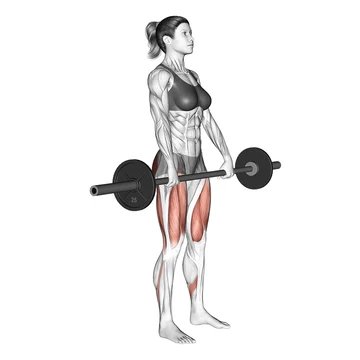
Hold the barbell in front of your thighs with a shoulder-width grip, standing upright with your knees only slightly bent.
1Starting position: Hold the barbell in front of your thighs with a shoulder-width grip, standing upright with your knees only slightly bent. - 2Downward movement:
Push your hips back instead of bending your knees - your legs stay almost straight. Guide the bar close along your legs.
2Downward movement: Push your hips back instead of bending your knees - your legs stay almost straight. Guide the bar close along your legs. - 3Bottom position:
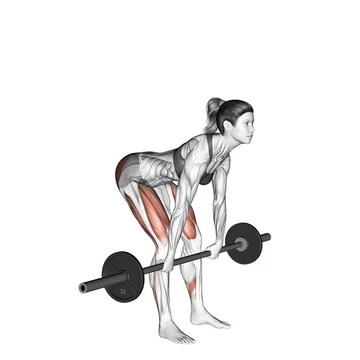
Lower until you feel a clear stretch in the back of your thighs - not to a fixed point on the floor, but to the limit of your individual hip mobility.
3Bottom position: Lower until you feel a clear stretch in the back of your thighs - not to a fixed point on the floor, but to the limit of your individual hip mobility. - 4Upward movement:
Return to an upright stance by extending your hips, keeping the bar close to your legs.
4Upward movement: Return to an upright stance by extending your hips, keeping the bar close to your legs. - 5Breathing:
Inhale and brace your core as you lower, exhale as you stand up.
5Breathing: Inhale and brace your core as you lower, exhale as you stand up.
The movement comes consistently from the hips, not from your back or knees - that's what sets the Romanian deadlift apart from the conventional deadlift, where the bar is picked up from the floor and the knees do more of the work.
Why this exercise is so effective
The Romanian deadlift primarily works the hamstrings (biceps femoris, semitendinosus, semimembranosus) and the glutes, with the lower-back extensors acting as stabilizers.
Three reasons the exercise targets the hamstrings so specifically:
Common mistakes
Variations
Sets and reps
For the Romanian deadlift, a range of around 3 sets of 8-12 reps has become established in training practice, with 1-3 reps left in reserve at the end of each set (RIR 1-3). This, too, is a general guideline, not a rigid rule.
OUR APPROACH AT 10 REPSIn the 10 Reps app, the Romanian deadlift is part of several training plans, including lower-body focused programs. The ProgressionEngine doesn't lock weight and reps in place - it adjusts them based on your feedback from the last session. Train consistently and cleanly, and the load goes up; need more recovery, and you get it, without the plan grinding to a halt.
Built-in deload weeks also make sure load gets reduced automatically on a regular basis, so you don't have to keep track of that yourself.
Conclusion
The Romanian deadlift lives on pure hip movement with almost straight legs - not on how deep the bar travels.
A neutral spine, keeping the bar close to your legs, and stopping at your own mobility limit are the three adjustments that decide both effectiveness and back health.
Part of our leg-exercises series - discover more essential leg exercises here: The 8 Best Leg Exercises for Stronger Legs.
Continue reading
Knowledge is the start.
The plan does the rest.
Everything we write about here — progression, recovery, structure — is built right into the app. 5 questions, and your first plan is ready.
Download on theApp Store