Strength Training for Runners - Worthwhile Addition or Waste of Time?
Heavy legs, less pace, wasted energy — that's what many runners fear from the weight rack. Research says something different.
 10 Reps Editorial
Heavy legs, less pace, wasted energy — that's what many runners fear from the weight rack. Research says something different: strength training doesn't make you slower.
It makes you more efficient.
What strength training does for your running economy
Running economy, in simple terms, is how much energy you need to hold a given pace. Less energy per kilometer means more reserve for the end of the race. And this is exactly where strength training pays off — heavy training with meaningful load in particular, plus supplementary jump training (plyometrics), measurably improves running economy. Light training with lots of reps or pure isometric holds barely move the needle. The type of training is what decides the outcome.
The effect doesn't only show up in the lab at rested pace — it also holds up when it actually matters: under high fatigue in the second half of a race, running economy stays more stable in runners who strength train. Exactly the phase where races get decided.
Does strength training actually prevent injuries?
This deserves honesty over a tidy soundbite. For sport in general, the picture is clear: people who strength train get injured less often. For runners specifically, it's more nuanced. Standalone strength or exercise programs without supervision don't reliably lower injury risk in studies — a clear protective effect only shows up once someone is coached and guided through it. The difference likely has less to do with the exercises themselves than with clean technique and adherence, both of which improve with guidance.
In short: strength training can protect you, but it's not automatic. How you do it matters more than whether you do it.
Does strength training steal energy from running?
The worry about the so-called interference effect isn't completely unfounded, but it's much smaller than its reputation suggests. Training strength and endurance in the same period does slightly blunt strength adaptations — running performance itself is usually unaffected. In practice, that means the order within a training day barely matters for running. For strength gains, it's slightly more favorable to lift first and run afterward rather than the reverse.
What matters most is the gap: if at least six hours separate a strength session from a hard run, the interaction is minimal either way.
What this means for your training
OUR APPROACH AT 10 REPSFor runners, strength training has to be one thing above all: plannable, without blowing up the running calendar.
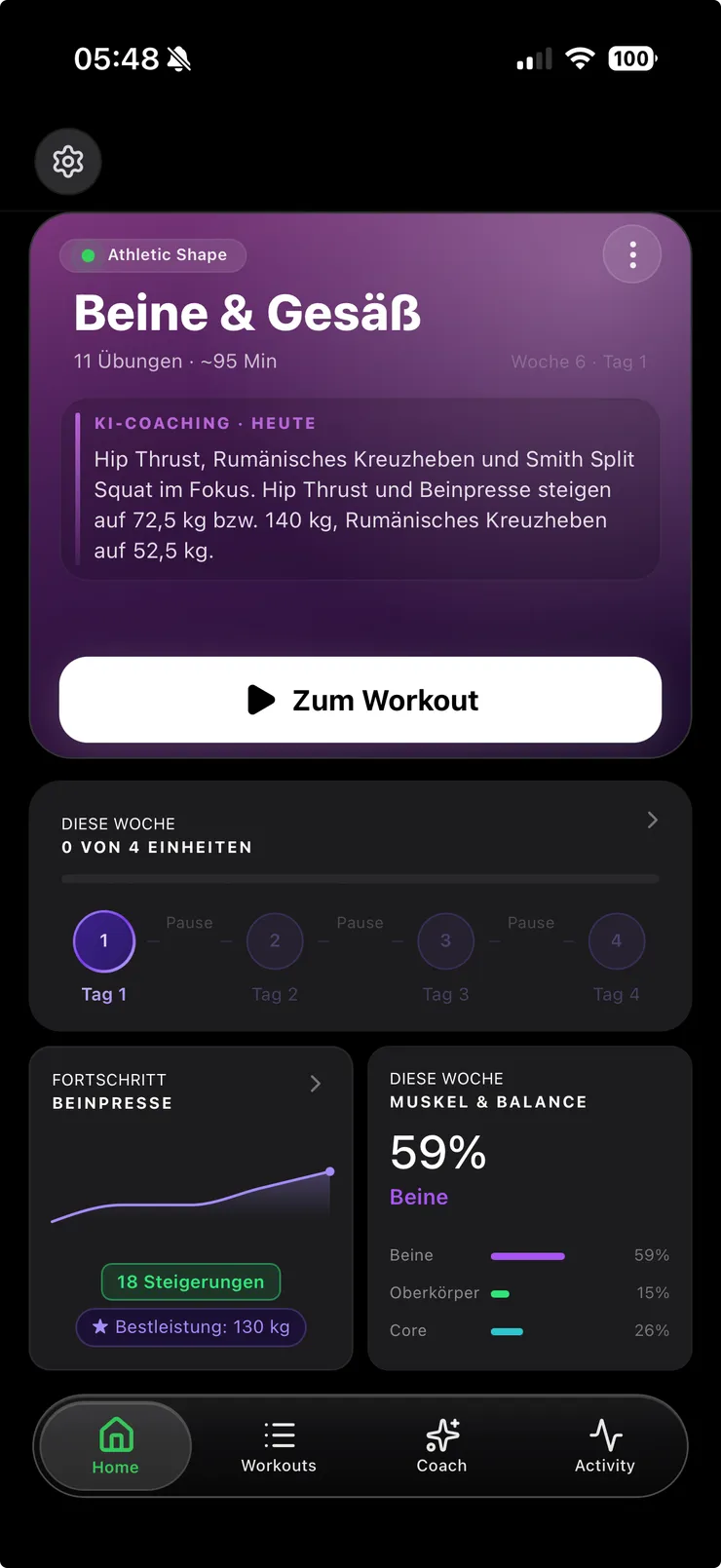
The 10 Reps workout library can be filtered by duration — everything from 20 to 60 minutes is available, so depending on how you're feeling and your running load, you can find a shorter, lower-body-focused session. Prefer a fixed structure instead? Activate one of the multi-week training plans.
Conclusion: A Worthwhile Addition, Not a Replacement
Strength training improves running economy in runners, and often race performance too. When it comes to injury protection, clean execution matters more than the training itself. And the fear of a negative interaction with running is largely unfounded with a bit of planning.
Not a replacement for running — but one of the best-supported additions to it.
- 1.Llanos-Lagos C, Ramirez-Campillo R, Moran J, Sáez de Villarreal E. "Effect of Strength Training Programs in Middle- and Long-Distance Runners' Economy at Different Running Speeds: A Systematic Review with Meta-analysis." Sports Medicine, 2024;54(4):895–932.
- 2.Llanos-Lagos C, Ramirez-Campillo R, Moran J, Sáez de Villarreal E. "The Effect of Strength Training Methods on Middle-Distance and Long-Distance Runners' Athletic Performance: A Systematic Review with Meta-analysis." Sports Medicine, 2024;54(7):1801–1833.
- 3.Zanini M, Folland JP, Wu H, Blagrove RC. "Strength Training Improves Running Economy Durability and Fatigued High-Intensity Performance in Well-Trained Male Runners: A Randomized Control Trial." Medicine & Science in Sports & Exercise, 2025;57(7):1546–1558.
- 4.Wu H, Brooke-Wavell K, Fong DTP, Paquette MR, Blagrove RC. "Do Exercise-Based Prevention Programs Reduce Injury in Endurance Runners? A Systematic Review and Meta-Analysis." Sports Medicine, 2024;54(5):1249–1267.
- 5.Chen Z, Wang J, Zhao K, He G. "Adherence to Strength Training and Lower Rates of Sports Injury in Contact Sports: A Systematic Review and Meta-analysis." Orthopaedic Journal of Sports Medicine, 2025;13(5):23259671251331134.
- 6.Vikestad V, Dalen T. "Effect of Strength and Endurance Training Sequence on Endurance Performance." Sports, 2024;12(8):226.
- 7.Hickson RC. "Interference of strength development by simultaneously training for strength and endurance." European Journal of Applied Physiology, 1980;45(2–3):255–263. (The original historical study behind the term "interference effect"; the current context cited in the text comes from source 6.)
Continue reading


Knowledge is the start.
The plan does the rest.
Everything we write about here — progression, recovery, structure — is built right into the app. 5 questions, and your first plan is ready.
Download on theApp Store