Building Muscle After 40 - What's Realistic and What Changes
Can you still build meaningful muscle at 40, 45 or 50? Yes - only the pace, protein needs and expectations change. What's really true and what's myth.
 10 Reps Editorial

- 1Building muscle stays possible at 40, 50 and 60 - after strength training, muscle protein synthesis responds similarly in older and younger adults in most studies.
- 2What changes is mainly the pace: slightly reduced sensitivity to nutrients, shifting hormone levels and a bit more need for recovery.
- 3Protein becomes more important as a nutrition lever: 1.6 to 2.2 grams per kilogram of body weight per day is the target range for building muscle, and creatine is a small optional extra.
After 40, many people who start (or restart) strength training or want to keep going run into a question that goes beyond training structure - we covered the training side in Strength Training After 40. The question here: do you still build meaningful muscle at 40, 45 or 50? Or has the window for visible gains basically closed?
Short answer up front: building muscle is still physiologically possible at 40, 50 or 60. What changes isn't the body's ability to respond to training stimuli - it's the pace, protein needs, and the expectations you bring to it. This article sorts out what's really true about "building muscle after 40" - and what's myth.
Anabolic resistance - what actually changes in the body
With age, the body responds somewhat more sluggishly to nutrients like protein. Research calls this anabolic resistance: muscle protein synthesis - the process by which the body builds new muscle tissue from amino acids - responds more weakly after a protein-rich meal than in younger people.
A recent systematic review and meta-analysis comparing adults aged 60 and over with 18- to 35-year-olds shows the extent more precisely than most blanket statements suggest: in the fasted state, muscle protein synthesis is only slightly reduced in older adults. After a meal, the difference is somewhat larger. The really decisive finding lies elsewhere, though: after a strength training session, most of the studies analyzed found no significant difference between younger and older adults - although the data for this state is less consistent than for the others. So the training stimulus appears to largely offset the reduced sensitivity to nutrients.
One caveat belongs here: the older adults studied were at least 60. This hasn't been measured directly for 40- to 50-year-olds - it's plausible that the differences are smaller there, but the direction stays the same: the muscle keeps responding to a well-set training stimulus. The door to muscle growth stays open - after 40 it just takes a bit more care to unlock: consistent training and nutrition that compensates for the reduced nutrient sensitivity.
Why the pace changes anyway
Even when the response to training is preserved, the hormonal backdrop shifts. In men, testosterone levels decline slowly over adult life - depending on the study, roughly on the order of one percent per year. In women, the hormonal shift isn't linear but concentrates on menopause, when estrogen levels fall sharply within a few years - with noticeable consequences for muscle and bone metabolism. If you want to know what that means in concrete terms, you'll find the deep dive in our article Strength Training During Menopause.
For building muscle, this means in practice: the maximum rate of gain per year can drop somewhat compared with your 20s, and recovery between intense sessions takes somewhat longer on average - a point already covered in Strength Training After 40. That doesn't change the direction, only the pace.
Realistic means: the first visible changes take several months of consistent training - as at any training age - not weeks. If you start or restart after 40, think in terms of years rather than weekly challenges. That isn't bad news, just the realistic timeline on which building muscle works at any age.
Why protein now plays a bigger role
Because muscle protein synthesis responds more weakly to individual meals, protein intake becomes a more important lever with age. The German Nutrition Society sets an estimated value of 1.0 gram of protein per kilogram of body weight for healthy adults aged 65 and over - deliberately higher than the 0.8 g/kg reference value for younger adults, explicitly citing the maintenance of muscle function in older age. There is no separate recommendation for the years after 40 - but the value shows the direction: protein needs rise with age rather than jumping suddenly at 65.
For actively building muscle with strength training, the established sports-science target range is 1.6 to 2.2 grams per kilogram of body weight per day. If you want to play it safe after 40, a pragmatic approach is to stay in the upper half of that range - there is no fixed age threshold for this. How to best spread that amount across the day and why the much-cited "anabolic window" right after training is a myth is something we've already covered in Protein Needs for Strength Training - nothing changes in the implementation after 40, at most the target amount tends to shift upward.
Besides training and protein, there's a third, much smaller lever: creatine. A meta-analysis in older adults shows more lean mass and higher strength values in combination with strength training - though with thinner evidence than in younger lifters. We've summarized its effect, dosing and safety in Creatine and Strength Training.
Training variables that decide success now
The training principles themselves don't change after 40: mechanical tension, progressive overload and sufficient recovery remain the decisive levers - the fundamentals are in Strength Training After 40, dosing is in Training Volume for Muscle Growth. For pure muscle building after 40, this mainly means one thing in practice: train moderately and consistently over months rather than pushing individual sessions to the limit. Consistency beats short-term intensity peaks - precisely because recovery between sessions, as described above, takes somewhat more time on average.
What this means for your training
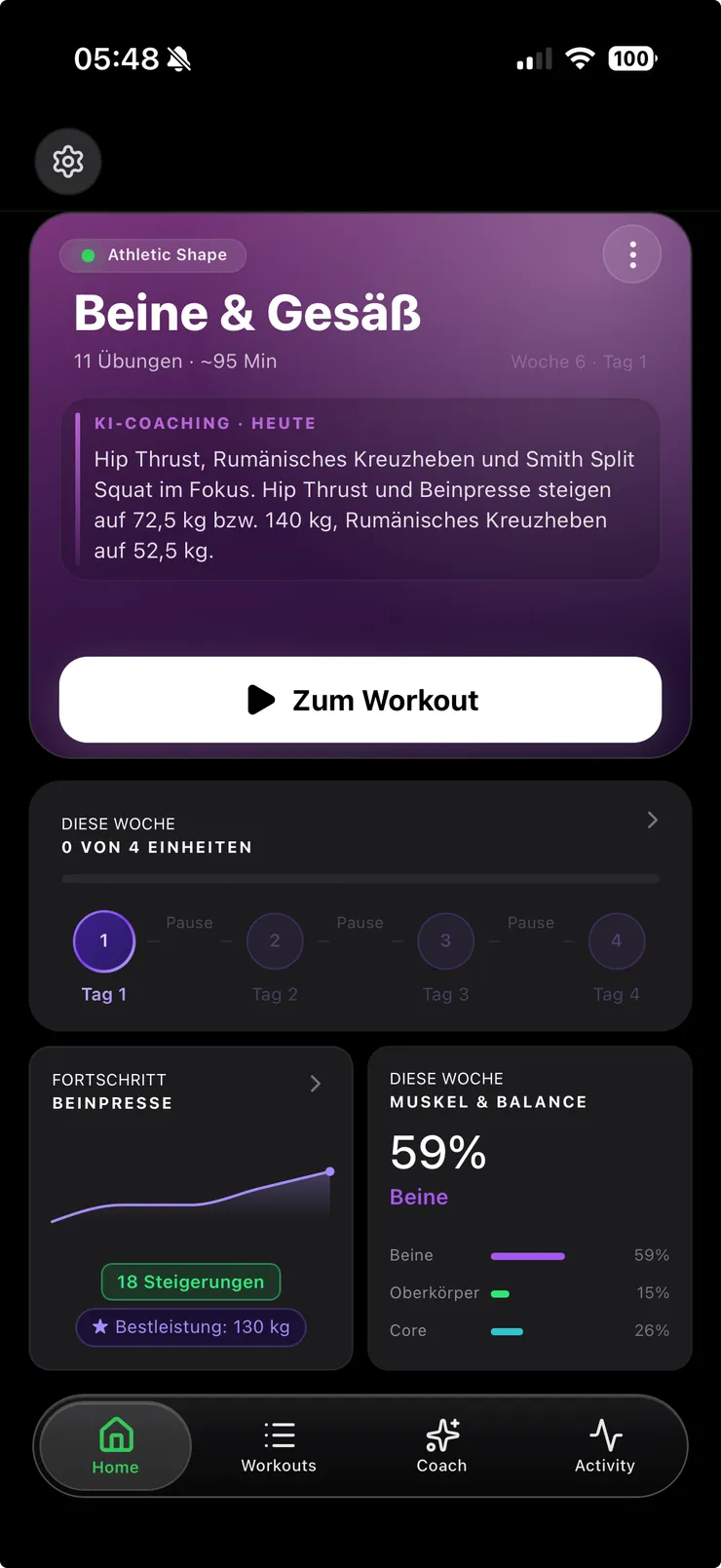
OUR APPROACH AT 10 REPSAt 10 Reps, building muscle after 40 isn't treated as a special case but as a question of the right dosage. The ProgressionEngine doesn't adjust weight, sets and reps on a rigid schedule but based on your actual feedback from each session - if you need more recovery time, you get it, without the plan grinding to a halt.
Built-in deload weeks automatically reduce the load and make sure load peaks get cushioned regularly. And because progress after 40 is often less linear than at 25, the app makes exactly that progress visible - over weeks and months, not just from one session to the next.
Conclusion: Building muscle after 40 - a bit slower, but real
The physiology of building muscle doesn't change fundamentally at 40. What changes is the starting point: slightly reduced nutrient sensitivity, shifting hormone levels, and a daily life that demands more attention to recovery.
If you deliberately manage these three things - training, protein, recovery - you can keep building muscle at 40, 50 or later. Not at the same pace as at 20, but still real.
Continue reading


Knowledge is the start.
The plan does the rest.
Everything we write about here — progression, recovery, structure — is built right into the app. 5 questions, and your first plan is ready.
Download on theApp Store