How to Start Strength Training the Right Way
For most people, the hardest part is walking into the gym for the first time — not the training itself. Too many machines, too many opinions, the feeling of doing something wrong.
 10 Reps Editorial
- 1Strength gains in the first few weeks come mainly from the nervous system learning to activate existing muscle better - not from new muscle mass.
- 2A full-body workout, two to three times a week, is just as effective for beginners as more complex splits like push-pull-legs.
- 3If soreness eventually stops showing up, that doesn't mean training stopped working - it usually just means your body has adapted to the movement.
For most people, the hardest part is walking into the gym for the first time — not the training itself. Too many machines, too many opinions, the feeling of doing something wrong.
Getting started is actually simpler than it feels, once you know what really matters.
The first few weeks count differently than you'd think
Train for the first time, and you'll get noticeably stronger within a short time — long before any difference shows up in the mirror. That's not chance, and it's not a placebo: in the first weeks, strength gains come mainly from the nervous system learning to activate existing muscle more effectively, not from new muscle mass being built. The muscle was stronger than it was being used the whole time; training teaches the body to tap into that potential.
For beginners, that means: fast progress in the first few weeks is normal, and no reason to jump the weight up too quickly. The body is busy learning the movement right now — that's worth more than any extra kilo on the bar.
Full-body over a split
If you're just getting started, you don't need to worry about Push-Pull-Legs or other splits. A full-body routine, two to three times a week, covers everything you need at this stage — easier to plan, easier to remember, and just as effective as more complex splits, as long as the training volume is right. There's time for splits later, once you have more training days and more experience.
Technique over weight
The biggest beginner mistake isn't too little weight — it's too much, too soon. A movement performed cleanly with full control gets you further than the same exercise with more weight but compromised technique. The first few weeks are exactly when movement patterns get established — better to start a bit lighter and learn clean technique than to train with compromises from day one.
Muscle soreness isn't proof it's working
Noticeable soreness after your first few sessions is normal — the body is reacting to an unfamiliar stimulus, not necessarily to particularly effective training. Worth knowing: if the soreness eventually stops showing up, that doesn't mean the training has stopped working. It usually just means the body has adapted to the movement — a sign of progress, not a warning sign.
Structure beats motivation
The biggest barrier to getting started is rarely a lack of motivation — it's the question "what am I actually doing today?" that drains energy every single time, before training has even begun. Anyone who has to decide fresh before every session which exercises, how many sets, and how much weight gives up sooner than someone following a fixed plan.
A simple, clearly structured plan takes that decision off your plate. Not because variety is bad, but because progress at the start needs one thing above all: enough repetitions of the same movements to actually compare, cleanly, whether something is improving. A plan followed consistently over several weeks beats any ad-hoc combination — even one that looks cleverer on paper.
What this means for your training
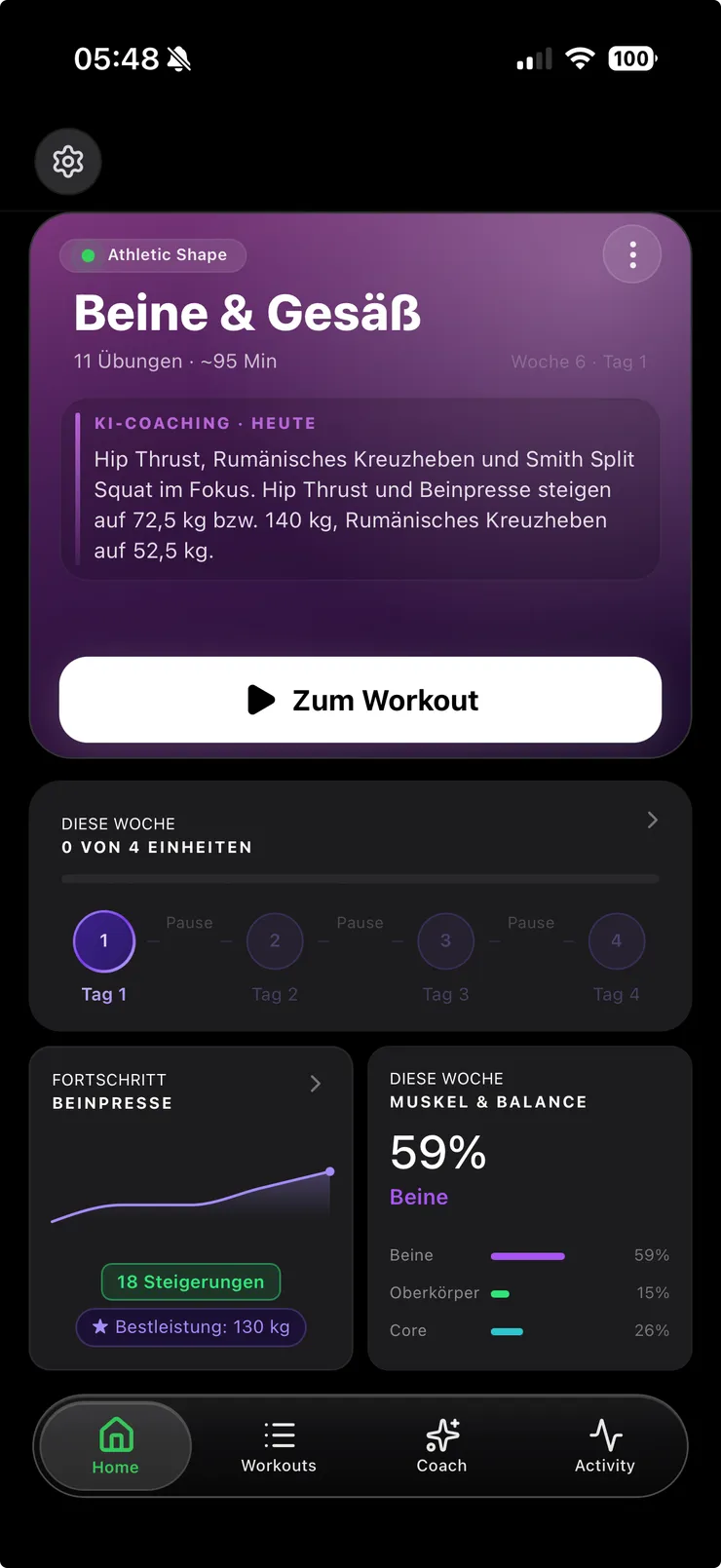
OUR APPROACH AT 10 REPSFor exactly this kind of decision fatigue, 10 Reps has the Gym Start plan: a ready-made full-body program, three sessions a week, with no need to piece together your own exercises, sets, or weights.
The progression engine handles the increases from session to session, so the only decision left before each workout is: show up or not. And after every session, the AI coach puts the workout in context — explained clearly, with no jargon you'd have to look up.
Conclusion: Start Simple, Stay Consistent
Strength training at the start doesn't need a complicated plan, specialized knowledge, or perfect technique from day one. What matters is a simple full-body plan, clean movement, and consistency over several weeks.
Everything else — more weight, more structure, more specialization — comes on its own, once the foundation is set.
- 1.Lecce E, et al. "Resistance training-induced adaptations in the neuromuscular system: Physiological mechanisms and implications for human performance." The Journal of Physiology, 2026.
- 2.Ratamess NA, Alvar BA, Evetoch TK, Housh TJ, Kibler WB, Kraemer WJ, Triplett NT. "Progression models in resistance training for healthy adults." Medicine & Science in Sports & Exercise, 2009;41(3):687–708.
- 3.Schoenfeld BJ, Grgic J, Krieger J. "How many times per week should a muscle be trained to maximize muscle hypertrophy? A systematic review and meta-analysis of studies examining the effects of resistance training frequency on muscular adaptations in trained individuals." Journal of Sports Sciences, 2019;37(11):1286–1295.
- 4.Schoenfeld BJ, Contreras B. "Is Postexercise Muscle Soreness a Valid Indicator of Muscular Adaptations?" Strength and Conditioning Journal, 2013;35(5):16–21.
Continue reading

Knowledge is the start.
The plan does the rest.
Everything we write about here — progression, recovery, structure — is built right into the app. 5 questions, and your first plan is ready.
Download on theApp Store